
Speaker
Description
Conventional μSR lacks external control over local muon–spin interactions; to overcome this limitation, we employed pulsed RF techniques to manipulate spin populations in muon-coupled fluoride systems at precisely controlled times after muon implantation, utilizing the ISIS pulsed muon beamline—well suited for such experiments. In ionic fluoride insulators, implanted μ$^+$ forms an F–μ–F complex (1), leading to three-spin entanglement and characteristic oscillations (2). We have implemented single and double resonance techniques, including multifrequency pulses, enabling precise manipulation of state populations within the F–μ–F system.
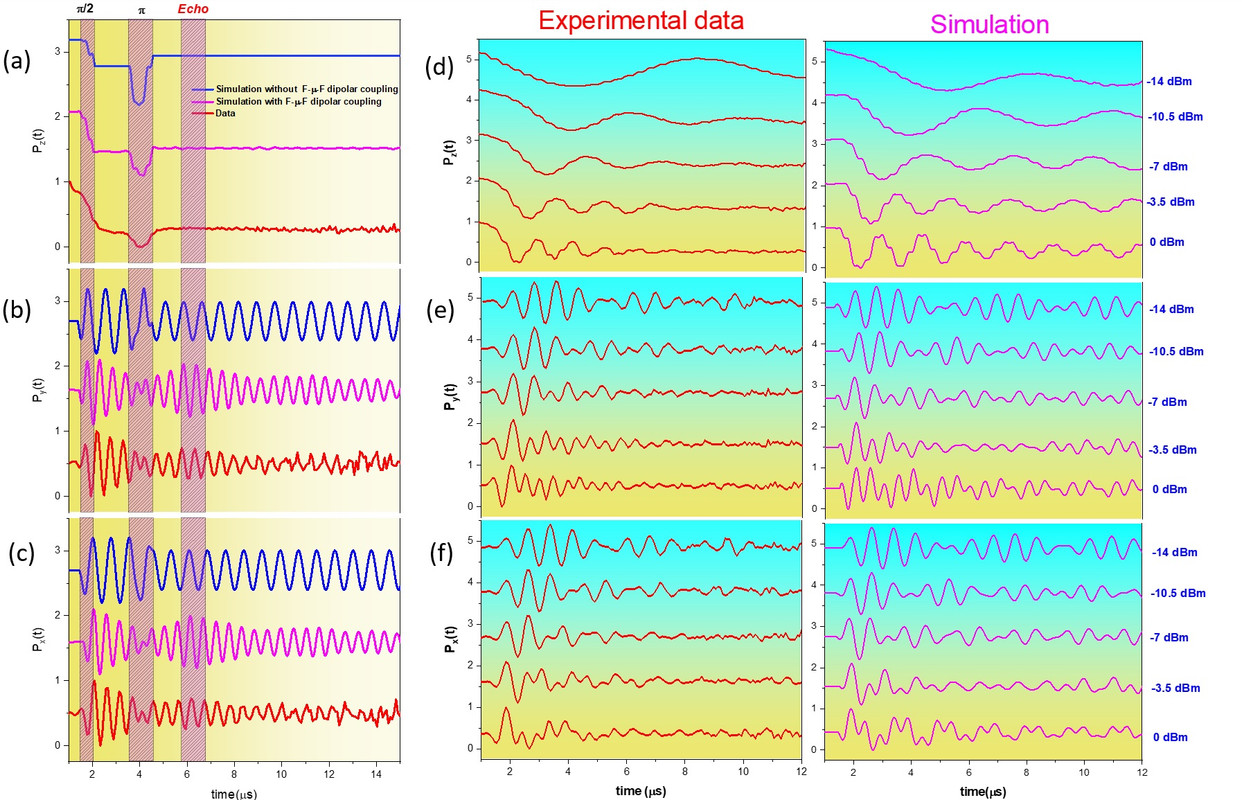
We present NMR-like μSR measurements using a Hahn echo (π/2–τ–π) sequence, demonstrating well defined spin echoes in the F–μ–F system, as shown in Fig.(a-c). Our data and simulations demonstrate a series of significant technical achievements, one of which is the precise control of muon and fluorine spins through RF amplitude ($B_1$) modulation, evidenced by a change in the Rabi oscillation frequency between split Zeeman energy levels as a function of RF power in the F–μ–F complex, as shown in Fig.(d-f).
(1) J. H. Brewer, et al., Physical Review B, 33(11):7813, 1986.
(2) T. Lancaster et al., Physical Review Letters,99(26):267601, 2007.
| dipranjan.chatterjee@physics.ox.ac.uk | |
| Funding Agency | UKRI (United Kingdom Research and Innovation) |
| Did you request an Invitation Letter for a Visitors Visa Application | Yes |