
Events in our system are self-managed.  Group and event managers are encouraged to review privacy and security settings, and adjust them if needed.  If you need assistance please contact Indico Support - contact Help at bottom of page. https://learn.getindico.io/categories/managing/

$\mu$SR Observation of Anisotropic Skyrmion and Meron Spin Dynamics in Centrosymmetric Gd$_2$PdSi$_3$

25 Jul 2025, 11:10
20m
Contributed Oral Magnetism Oral Contributions

Speaker

Murray Wilson (Memorial University of Newfoundland)

Description

Skyrmion lattices (SkLs) are intriguing vortex-like spin textures with non-trivial topology [1,2]. While they are typically stabilized by antisymmetric interactions in bulk noncentrosymmetric materials, centrosymmetric SkL hosts, such as Gd$_2$PdSi$_3$ [2–4], have recently been discovered. There, both the SkL stabilization mechanism under applied fields and the zero-field ground states (GSs) remain controversial.

To address these questions, we have investigated the spin dynamics in Gd$_2$PdSi$_3$ using µSR [5]. We find highly anisotropic spin fluctuations in its SkL phase [Fig. 1(a)], suggesting a prominent role of anisotropy in SkL stabilization. Intriguingly, we also observe anisotropic dynamics in the GS [Fig. 1(b)], implying that it is a complex meron spin texture, confirming Ref. [4] and refuting other predictions.

Our µSR study Ref. [5] highlights the importance of spin anisotropy even in centrosymmetric SkL hosts and strongly constrains possible SkL stabilization mechanisms.
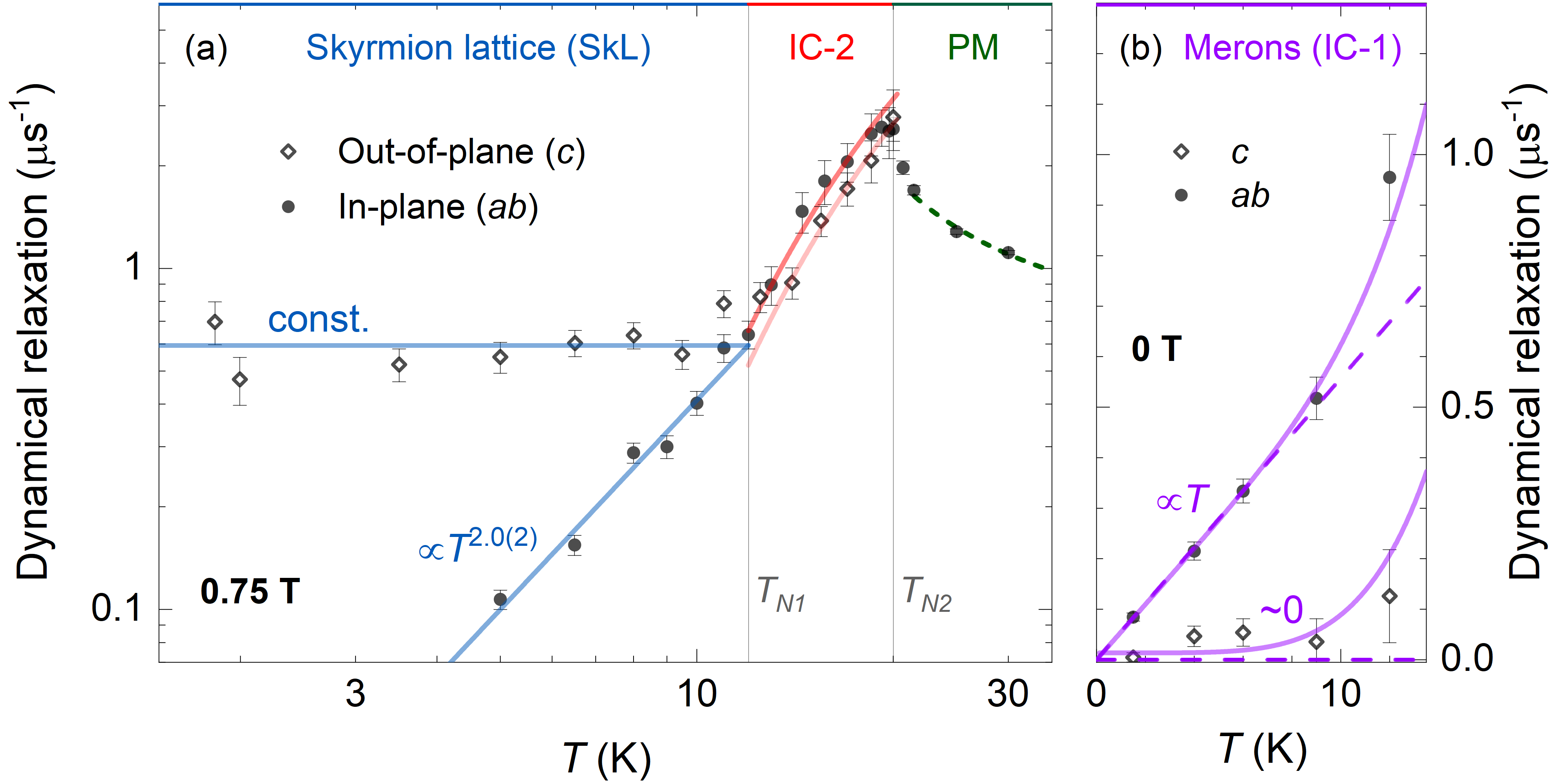

Fig. 1. Muon relaxation in Gd$_2$PdSi$_3$ in (a) the SkL, fanlike (IC-2), and paramagnetic (PM) phases in 0.75 T; and (b) in the meron GS.

[1] T. Lancaster, Contemp. Phys. 60, 246 (2019).
[2] J. Khatua et al., Phys. Rep. 1041, 1 (2023).
[3] S. Li et al., Interdiscip. Mater. 2, 260 (2023).
[4] T. Kurumaji et al., Science 365, 914 (2019).
[5] M. Gomilšek et al., Phys. Rev. Lett. 134, 046702 (2025).

Email matjaz.gomilsek@ijs.si
Funding Agency Slovenian Research and Innovation Agency (ARIS, Slovenia), Engineering and Physical Sciences Research Council (EPSRC, UK)
Did you request an Invitation Letter for a Visitors Visa Application No

Primary authors

Dr Matjaž Gomilšek (Jožef Stefan Institute & Faculty of Mathematics and Physics, University of Ljubljana) Murray Wilson (Memorial University of Newfoundland) Thomas Hicken (Paul Scherrer Institute) Dr Kévin J. A. Franke (School of Physics and Astronomy, University of Leeds, LS2 9JT, United Kingdom & Department of Physics, Durham University, South Road, Durham DH1 3LE, United Kingdom) Dr Benjamin Huddart (University of Oxford) Dr Aleš Štefančič (Department of Physics, University of Warwick, Coventry CV4 7AL, United Kingdom) Samuel J. R. Holt (University of Warwick) Geetha Balakrishnan (University of Warwick) Daniel Mayoh (University of Warwick) Dr Max T. Birch (Max Planck Institute for Intelligent Systems, Heisenbergstrasse 3, D-70569 Stuttgart, Germany & RIKEN Center for Emergent Matter Science, JP-351-0198 Wako, Japan & Department of Physics, Durham University, South Road, Durham DH1 3LE, United Kingdom) Dr Samuel H. Moody (Laboratory for Neutron Scattering and Imaging, Paul Scherrer Institut, 5232 Villigen PSI, Switzerland & Department of Physics, Durham University, South Road, Durham DH1 3LE, United Kingdom) Hubertus Luetkens (Paul Scherrer Institute) Zurab Guguchia (Laboratory for Muon-Spin Spectroscopy, Paul Scherrer Institut, CH-5232 Villigen PSI, Switzerland) Dr Mark T. F. Telling (ISIS Facility, STFC Rutherford Appleton Laboratory, Didcot, Oxfordshire OX11 0QX, United Kingdom) Peter Baker (ISIS Pulsed Neutron and Muon Source, STFC Rutherford Appleton Laboratory) Stewart Clark (Durham University) Tom Lancaster (Durham University)

Presentation materials