Choose timezone
Your profile timezone:
Events in our system are self-managed. Group and event managers are encouraged to review privacy and security settings, and adjust them if needed. If you need assistance please contact Indico Support - contact Help at bottom of page. https://learn.getindico.io/categories/managing/
TRIUMF, Canada's national particle accelerator centre, is proud to host the 20th International Conference on Electromagnetic Isotope Separators and Related Topics (EMISXX) at Fairmont Chateau in Whistler from October 19 - 24, 2025.

As per its tradition, EMISXX aims to bring together researchers from across different fields, working on electromagnetic separators and related nuclear science, to discuss topics of:
Conference Program at a Glance
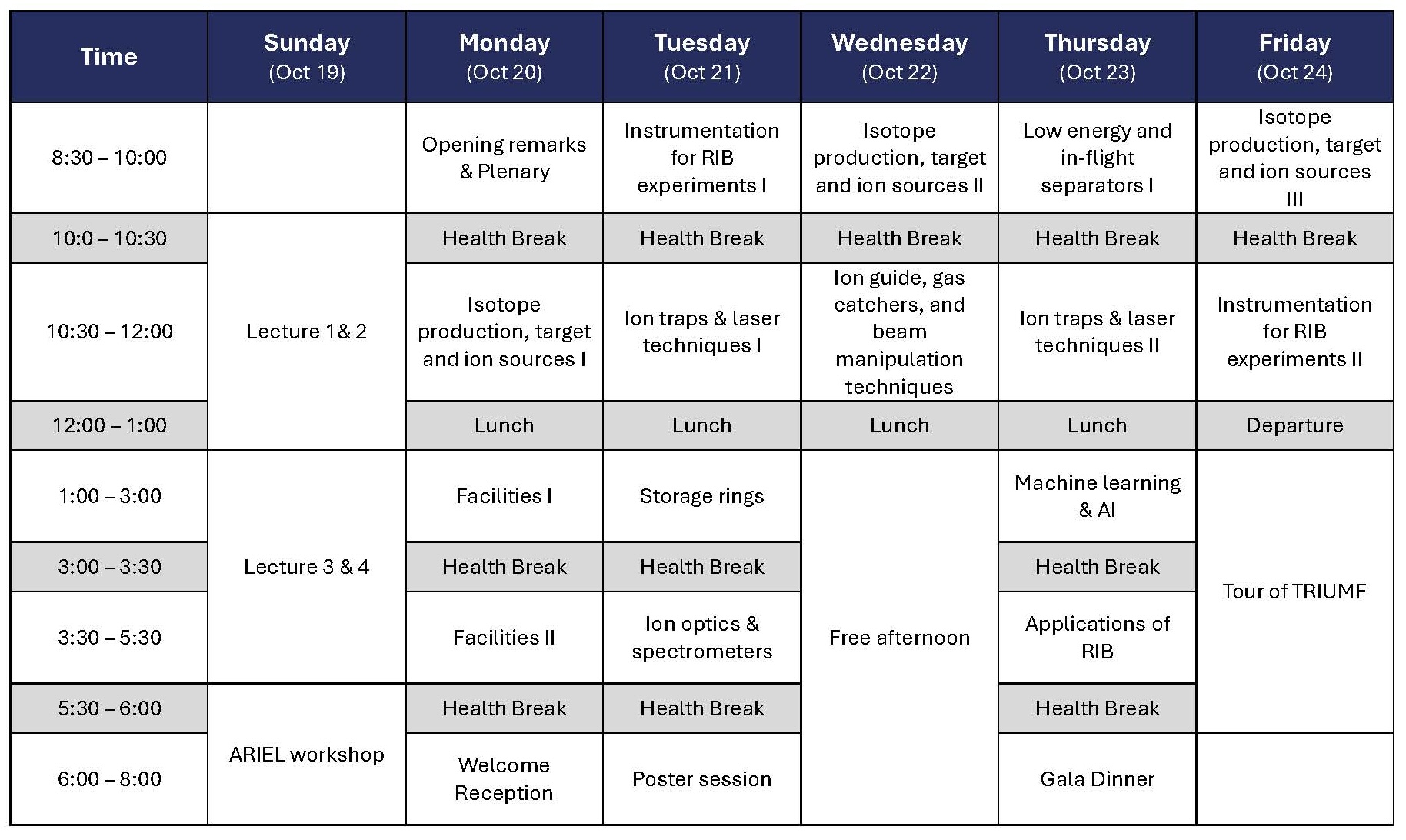
We look forward to seeing you there!
The Facility for Rare Isotope Beams, FRIB, started operation in May 2022. Since then, over 400 rare isotope beams have been separated and used in 58 experiments ranging from nuclear structure to creation of generators for medical diagnostics. The FRIB superconducting LINAC has provided primary beams ranging from $^{18}$O to $^{238}$U at energies from 130 MeV/u to 290 MeV/u. Rare isotope beams are formed in-flight using the Advanced Rare Isotope Separator, ARIS. ARIS incorporates a number of features, including infrastructure to operate at 400 kW, momentum compression to better match rare isotope beams to the subsequent experiments, and vertical and horizontal dispersive sections. So far, 12 new isotopes have been identified at FRIB, including $^{71}$Cr, which is predicted to be weakly bound. The talk will review the features of ARIS along with operational experience and first results.
The MORA project (Matter’s Origin from Radioactivity) is an experimental setup dedicated to measure the triple-correlation parameter D in the nuclear beta decay of $^{23}$Mg and $^{39}$Ca. The $D$ correlation is a triple correlation between the spin of the decaying nucleus, the momentum of the emitted electron or positron, and the momentum of the emitted neutrino in mixed Fermi and Gamow-Teller transitions. The $D$ parameter is sensitive to physics beyond Standard Model, allowing to probe charge-parity (CP) violation mechanisms as a condition to matter-antimatter imbalance [1].
MORA consists of a transparent Paul trap and an octagonal arrangement of detectors mounted around it for positron and recoil ion detection. Trapped $^{23}$Mg ions are polarized with lasers and then let to decay while observing emitted particles. The degree of polarization is continuously monitored with silicon detectors [2].
In this contribution, the proof-of-principle of the in-trap laser polarization technique will be reported. The measurements were performed in the accelerator laboratory of University of Jyvaskyla, Finland, in IGISOL facility.
[1] A. Falkowski, A. Rodriquez-Sanchez, EPJC 82 (2022) 1134.
[2] N. Goyal et al., Performance of the MORA Apparatus for Testing Time-Reversal Invariance in Nuclear Beta Decay, arXiv:2504.16957v1 (2025).
Isotope Separator On-Line (ISOL) facilities are central to the production of high-purity radioactive ion beams (RIBs) for a variety of research applications. Emerging facilities are increasingly focused on high-power operation, where radioisotope yields are expected to scale directly with the primary beam power. However, significant engineering challenges must be addressed to ensure that high-power Target and Ion Source Systems (TISS) are as efficient as those operating in the low-power regime. Moreover, RIB yields at ISOL facilities typically degrade over time due to extreme operating conditions—such as targets and ion sources functioning at temperatures exceeding 2000 °C—a problem expected to intensify in high-power TISS scenarios.
TISS development typically aims to maximize the efficiency of isotope extraction and ionization, enabling access to shorter-lived isotopes and even new elements. In parallel, the growing interest in using the ISOL technique to produce research-scale quantities of novel medical isotopes introduces new challenges. For example, high-throughput ion sources with high ionization efficiencies are increasingly in demand. High-power targets, in particular, face issues such as cold spots that can trap isotopes of interest, or high mechanical stresses in target disks caused by localized beam power deposition. Offline extraction, from previously irradiated targets or even external sources of radioisotopes has also become of interest, introducing new challenges into the ISOL systems. Other TISS related components such as converter targets (e.g. proton to neutron, electron to gamma), in-situ purifying transfer lines or reactive gas leaks or dispenser ovens for molecular beam formation can also be part of the TISS, opening up new beams for the applications mentioned, but making them even more complicated which can affect the TISS reliability.
Research on targets and ion sources systems is often conducted as small, isolated projects driven by the scientific interests of the user community. These technological advancements can lead to significant increases in RIB yields and enable access to new isotopes and elements at the extremes of the nuclear chart. This lecture aims to provide a comprehensive overview of the present and future ISOL facilities and their status, with a focused discussion on their recent technological developments in target and ion source systems (TISS).
The properties of heavy neutron-rich nuclei are critical to explain the formation and existence of heavy elements in the universe. However, it is well known that certain regions on the nuclear chart, particularly those heavier and more neutron-rich than the heaviest stable primary beams, i.e., $^{238}$U, cannot be accessed using conventional production methods. Among the alternative approaches, multinucleon transfer (MNT) reactions have emerged as the most promising mechanism for reaching these challenging regions. MNT reactions also offer an efficient route for producing exotic isotopes along the line 𝑁=126, which are relevant to the origin of the third abundance peak in the rapid neutron-capture process (r-process). Realizing the full potential of this method will require the use of neutron-rich secondary beams.
To explore this potential, the Super-FRS experiment collaboration has started a program to conduct MNT experiments at GSI/FAIR. These experiments will utilize both stable and, eventually, secondary beams at the FRS and the Super-FRS. The reaction targets are located inside the cryogenic stopping cell, and the identification of the reaction products is performed using the high-resolution and broadband MR-TOF-MS. Tests at the FRS Ion Catcher have confirmed the feasibility of this experimental design [1]. The future Super-FRS Ion Catcher, equipped with a larger stopping cell, will enable MNT studies with highly intense beams.
This contribution will present preliminary results obtained using 238U stable beams, as well as further tests and plans involving secondary beams.
[1] A. Mollaebrahimi et al., NPA, 1057 (2025) 123041
The Isotope Separator and Accelerator (ISAC) facility at TRIUMF is a world class laboratory for the production and delivery of rare isotopes. ISAC uses the isotope separation on-line (ISOL) method to create a variety of exotic isotopes, utilizing high-intensity proton beams from TRIUMF’s 500 MeV cyclotron. The proton beam is impinged on a thick target which sits inside a target assembly. The target assembly sits inside a target module which is responsible for delivering all services (high voltage, high current, low voltage signals, vacuum, cooling and gas injection) from the target stations, through a section of shielding, to the operating target.
Maintaining reliable beam delivery to experiments is a cornerstone of ISAC’s mission, which becomes more challenging as the facility ages and the demand for new beams and new operational modes increases. This contribution will give an overview of recent changes at ISAC, highlighting efforts to increase reliability through improvements to high voltage operation and infrastructure, and a first-time target module refurbishment program. In addition we will discuss expanded options for users made possible through new target designs, improved laser ionization schemes and new methods of operation.
High-spin nuclear isomers in rare unstable beams are important for studies in nuclear structure, nuclear astrophysics, and applied research. While fragmentation reactions, widely used at in-flight rare-isotope beam facilities, can produce a diverse range of nuclides, the selective and high-intensity production and separation of specific isomer states remain challenging. This study aimed to experimentally investigate the correlation between parallel momentum transfer and angular momentum transfer in fragmentation reactions, contributing to the development of selective beam production techniques for isomer states.
We focused particularly on previous studies [1] that showed an increase in the isomer ratio by selecting the tail of the fragment momentum distribution, with the goal of clarifying its physical origin. In this research, we investigated the correlation between angular momentum and parallel momentum transfer by selecting events from high-spin isomer states and comparing their momentum distributions with those of events primarily in the ground state.
The experiment was conducted at the SB2 beamline of the High-Energy Heavy-Ion Accelerator Facility (HIMAC). Primary beams of $^{58}$Ni and $^{59}$Co accelerated to 350 MeV/u irradiated a 14 mm thick $^{9}$Be target to produce nuclides around $^{52}$Fe through fragmentation reactions. The produced fragments were separated by a fragment
separator (two dipole magnets) and identified using the time-of-flight (ToF), energy loss($\Delta$E), and magnetic rigidity (B$\rho$) method. Among the identified nuclides, de-excitation gamma rays from high-spin isomers $^{52m}$Fe(12$^+$), $^{53m}$Fe(19/2$^-$) and $^{54m}$Co(7$^+$) were measured using four Ge detectors placed at the end of the
flight path with the particle identification.
As a result of the analysis, a clear tendency was observed for the relative production of high-spin isomers to increase in the region of large momentum transfer away from the center of the fragment momentum distribution (the tail of the distribution), consistent with previous studies [2][3]. Furthermore, by comparing the measured properties of multiple isomer states, a clear positive correlation was found between the magnitude of the imparted angular momentum and the parallel momentum transfer.
In this presentation, we will report these experimental results in detail and discuss the current understanding of the angular momentum generation mechanism in fragmentation reactions and its potential application to the production of high-purity, high-intensity isomer beams.
[1] Schmidt-Ott, et al., Zeitschrift für Physik 350 215-219 (1994)
[2] Daugas, J. M. et al., Phys. Rev. C 63 064609 (2001)
[3] M. Notani et al., Phys. Rev. C 76 044605 (2007)
RAON (Rare isotope Accelerator complex for ON-line experiments) is Korea's flagship heavy-ion accelerator facility, established to advance fundamental research on rare isotopes and their applications. The construction of the facility—including building infrastructure, installation of the low-energy superconducting linac (SCL3) with its injector system, the ISOL (Isotope Separation On-Line) rare isotope production system, and associated experimental systems—was completed in 2021. Following the completion of Phase I of the RAON construction project in 2022, the first beam commissioning of the low-energy linac SCL3 using stable argon beams was successfully conducted in December 2023. In March 2023, the RAON ISOL system produced its first rare isotope beam—sodium ions—by irradiating a SiC target with a 70 MeV proton beam from the cyclotron. In 2024, RAON began providing low-energy beams via the accelerator and ISOL system for user experiments. This talk presents the current status and an overview of the RAON heavy-ion accelerator facility.
TRIUMF's ISAC facility operates ISOL targets under high-power particle irradiation up to 500 MeV and 100 μA of current, producing Radioactive Ion Beams (RIBs) for Canadians and international nuclear and particle physics experiments. The ARIEL facility (Advanced Rare IsotopE Laboratory) is currently under construction with the objective to add two RIBs, in addition to the RIB already being produced by the existing ISAC facility. One ARIEL station will receive a driver beam of 500 MeV protons, up to 100 μA from TRIUMF’s H- cyclotron. The other ARIEL station will utilize an electron beam from the new superconducting linear accelerator, with energy up to 35 MeV and up to 100 kW beam power. The addition of these two ISOL targets enables the delivery of three simultaneous RIB beams to different experiments, while concurrently producing radioisotopes for medical applications.
This contribution will describe the target station and its completion status, and will highlight the recent qualification tests that have been performed on its core components in our offline facility. The predicted beam intensities from the additional two stations will be presented, highlighting the main strengths and weaknesses of this combined facility. Moreover, the current status of the ARIEL facilities will be discussed, along with the roadmap their completion and ramp-up.
The growing demand for more intense and diverse exotic beams has driven the development of a new high-temperature ISOL (Isotope Separation On-Line) target for the SPIRAL1 (Système de Production d’Ions Radioactifs Accélérés en Ligne) facility at GANIL (Grand Accélérateur National d’Ions Lourds). The primary objective is to enhance the production yields of several radioactive isotopes of physical interest while ensuring compatibility with the thermal and mechanical constraints of the Target-Ion Source System (TISS).
Currently, radioactive isotopes at SPIRAL1 are produced using primary beams ranging from $^{12}$C to $^{238}$U (< 95 MeV/u, < $2\times10^{13}$ pps), impinging on a graphite target to induce beam fragmentation. To improve the production efficiency and expand the isotope diversity, alternative target materials are being investigated to replace graphite. This new target material will be used with a $^{12}$C primary beam to induce target fragmentation.
Several candidate materials—including Nb, ZrO$_2$, and Y$_2$O$_3$—were selected based on bibliographic research of ISOL target materials and theoretical estimations of isotope production cross-sections. Their suitability is being assessed by analyzing diffusion and effusion characteristics using literature data. Numerical simulations will be carried out using a parametric thermal model developed in ANSYS to evaluate the steady-state temperature distribution within targets of different geometries and compositions. These simulations will provide an insight into the expected release efficiencies as the produced isotope effusion and diffusion depend of the material properties, thermal gradients, microstructure and geometry of the target. In parallel, high-temperature stability and chemical compatibility of the selected materials are being investigated to ensure reliable operation under SPIRAL1 conditions.
Based on these studies, a prototype target will be co-designed in collaboration with GANIL’s mechanical engineering division. This prototype aims to experimentally validate the thermal and mechanical performance of the proposed materials under realistic irradiation conditions. Iterative optimization informed by simulation data will guide the final geometry design.
This development is a key component of the broader effort to expand GANIL’s radioactive ion beam capabilities. It supports the long-term objective of delivering a wider range of exotic beams for nuclear physics and interdisciplinary research, including future experiments at the SPIRAL2-DESIR low-energy facility.
The ISOL facility under development by the Belgian Nuclear Research Centre (SCK CEN), ISOL@MYRRHA, will leverage a fraction of the MYRRHA accelerator's proton beam to produce radioactive ion beams (RIBs). Already built as part of MYRRHA phase 1, the facility will receive in this phase a 100-MeV proton beam, up to 0.5 mA.
With the aim of producing high-intensity RIBs for several research programs, the performance of the production targets is a critical parameter. This contribution will present developments on the target design for the initial deployment phase of the facility known as Day-1. Investigations on Day – 1 target materials will also be covered. Furthermore, the latest progress will be discussed for the design and engineering of key components such as the proton beam window and the target vessel. These must be capable of withstanding the demanding operational conditions of ISOL@MYRRHA Day-1.
To provide users with information on nuclides that can be produced and identify the better suited targets and ion sources in terms of yields and beam purity, a database of production yields is being developed. The methodology for building this database along with its two-part structure will be shown. Furthermore, the findings of this study will also be discussed.
Lastly, highlights will be presented for the ongoing efforts to establish and commission test stands and offline setups. These setups are essential for developing target materials, target components, ion sources, beam windows and laser-ionization schemes.
A milestone of the 2024 ISAC RIB campaign at TRIUMF was the successful extraction and measurement of 14Be at the GRIFFIN detector. The interest for 14Be production in ISAC is mainly driven by the beta-decay studies of halo nuclei and their mass measurements. Due to the low production rate of 14Be and its very short half-life (4.35 ms), this rare exotic isotope challenges the limits of the ISOL targets and laser ion sources.
To achieve the goal of 14Be production a new tantalum target was optimized for fast isotope releases, heat transfer, and in target production. Analysis, simulations and experimental studies led to the development of a target with thinner tantalum foils and a total target thickness 40% of a standard ISAC target. The proton beam was rotated on the tantalum target for a more uniform temperature distribution, at an unprecedented high intensity of 85 micro-amperes (40.8 kW). An optical diagnostic to measure and monitor the temperature of the target in real time was used during the target run.
This work reports on the 14Be campaign, the target design, real-time diagnostics, beam delivery techniques and yields of other short-lived isotopes such as 12Be, 11Li, 9Li and 8Li.
The forthcoming DESIR facility will soon open new perspectives for low-energy nuclear physics experiments at GANIL. Radioactive ion beams from SPIRAL1 and S³ facilities, including very exotic isotopes produced at competitive rates for dedicated studies, are set to be delivered at low energy, low emittance and with high purity to various mass measurement, decay spectroscopy or laser spectroscopy experiments.
Two setups currently developed at LP2i Bordeaux are key parts of this objective. BuRI‑To (“Bunching Radioactive Ions To…”, known as “GPIB” while it is being commissioned in Bordeaux) is a radiofrequency quadrupole cooler buncher to be installed at the entrance of the DESIR hall. It will deliver either continuous or bunched beams, with low emittance and high efficiency, adapted to the specific needs of each experiment (adapted bunch length, energy dispersion, etc.).
Also under development at Bordeaux, PIPERADE (« PIèges de PEnning pour les RAdionucléides à DESIR ») is a double Penning trap which has a double purpose in the DESIR hall. Located shortly downstream of BuRI‑To, it will allow high-resolution mass purification of the radioactive ion beams, with resolving powers up to 107. This enables the separation of low-lying isomeric states from their ground states and therefore allows isomerically-pure beams to be exploited by the downstream experiments in the DESIR hall. In addition, PIPERADE is also designed for high-precision mass measurements with the use of Time-of-Flight Ion-Cyclotron Resonance (ToF-ICR) and Phase-Imaging Ion-Cyclotron Resonance (PI-ICR) techniques.
This presentation will provide an overview on the commissioning work on both setups in Bordeaux, before their move to GANIL planned to start in 2026.
Stuart Warren*, R. Eichler, M. Hartmann, A. Ivanov, S. Jollet, H. Jöhri, R. Hübscher, D. Kiselev, D. Laube, R. Martinie, M. Mostamand, D. Reggiani, J. Snuverink, N. van der Meulen, U. Wellenkam
Paul Scherrer Institute, PSI Forschungsstrasse 111, 5232 Villigen PSI, Switzerland
Stuart.warren@psi.ch
TATTOOS (Targeted Alpha Tumour Therapy and Other Oncological Solutions) is the next major installation at the Paul Scherrer Institute as part of the IMPACT project[1]. It envisages the use of the high intensity high energy proton beam from the ring cyclotron (HIPA, 590MeV 2.4 mA H+) to impinge on high Z targets for spallation produced radionuclides. The facility is, by design, a high throughput machine, with expected 100 uA proton beams impacting the target, producing a high yield of isotopes (>GBq Tb149) via spallation, online mass separation and laser ionization with less than 2% neighbouring mass contamination.
Here, we present the current status of the designs and layout for the core features of the facility; the high throughput electromagnetic separator with the moderate resolution of 3000 for typical surface source ion beams, the subsequent ion beamline systems and services, proposed collections, and proposed layout in the confined space of the site.
The facility aims to be the silver bullet in the production bottleneck of radionuclides for oncological solutions, bridging the gap between the technology and the clinical trial solution with medically relevant quantities of radionuclides.
[1] Eichler, R., Kiselev, D., Koschik, A., Knecht, A., van der Meulen, N., et Al (2022). IMPACT conceptual design report. (PSI Bericht, Report No.: 22-01). Paul Scherrer Institute.
The polarizer facility at TRIUMF-ISAC is a versatile facility for delivering highly nuclear-spin-polarized radioactive isotope beams (RIB) to various experiments and conducting collinear fast-beam laser spectroscopy to investigate nuclear shapes and charge radii. In recent years, there has been growing interest in novel nuclear-spin-polarized beams which drives further research and development. A series of innovations have been implemented: upgrades of laser and beamline systems, developments of Rydberg-atom field-ionizer and fluorescence polarimeter, and improvements in photon detection of fluorescence. Meanwhile, we are pursuing a universal laser-nuclear-polarization method through spin exchange optical pumping (SEOP). Additionally to facilitate nuclear-spin polarization through direct optical pumping of exotic isotopes with unknown atomic structures, collinear fast-beam laser spectroscopy is conducted to precisely measure isotope shifts and hyperfine structures, which also offers valuable insights into the nuclear shapes and charge radii of these isotopes.
Tackling the increasing challenge to determine the mass of isotopes having low production yields and short half-lives, multi-reflection time-of- flight (MRTOF) mass spectrometry has grown from an initially rarely-used technology to the world’s most commonly-used method for measurements with a relative mass precision down to $\delta m/m = 10^{−8}$. This technology has been developed at RIKEN’s RIBF facility for about two decades in combination with gas-filled ion catchers for low-energy access of isotopes produced by the in-flight method.
In the recent years, three independent systems operating at different access points at RIBF, have provided substantial data in the medium- and heavy-mass region of the nuclear chart, reaching out to the superheavy nuclides. Recent achievements like high mass resolving power [1] followed by the development of α/β-TOF detectors [2] and in-MRTOF ion selection have tremendously increased the selectivity of the systems. The combined application allows for background-free identification of the rarest isotopes. In this contribution, I will give a short overview about the success of MRTOF atomic mass measurements using BigRIPS in the recent past [3-5], and report new achievements from 2024. I will discuss the instrumentation plans, with a view to future MRTOF systems in other facilities of East Asia, and the combination of mass measurements with established setups for $\beta-\gamma$ spectroscopy using a through-beam gas cell.
References:
[1] M. Rosenbusch et al., Nucl. Instrum. Meth. A 1047, 167824 (2023).
[2] T. Niwase et al., Theo. Exp. Phys. 2023(3), 031H01 (2023).
[3] S. Iimura et al., Phys. Rev. Lett. 130, 012501 (2023).
[4] D. S. Hou et al., Phys. Rev. C 108, 054312 (2023).
[5] W. Xian, S. Chen et al., Phys. Rev. C. 109, 035804 (2023).
Investigating the boundaries of the nuclear chart and understanding the structure of the heaviest elements are at the forefront of nuclear physics. The existence of the superheavy nuclei is intimately linked to nuclear shell effects which counteract Coulomb repulsion and therefore hinder spontaneous fission. In the region of heavy deformed nuclei weak shell gaps arise around $Z$=100 and $N$=152 as well as around $Z$=108 and $N$=162. However, the extension of these gaps and their impact on the structure of these exotic nuclei, especially the most neutron-rich ones, is not yet fully understood, as most of the relevant nuclear systems are not experimentally addressed due to limited production capabilities, i.e. available beam-target combinations and/or corresponding low yields. Moreover, heavy and superheavy nuclides feature often metastable excited states with half-lives that can exceed the one of the ground state. Long-lived isomeric states can have excitation energies of only few tens of keV or below, therefore, their identification is challenging, especially in decay-based measurements.
On the other hand, Penning-trap mass spectrometry allows the experimental determination of the binding energy and, when applied to isotopic chains crossing shell gaps can provide information concerning the evolution of the shell gap strength without the detailed knowledge of the structure of the nuclei under study. Moreover, mass measurements with Penning traps feature sufficient resolving power to allow the separation of isomeric states when they are populated in the same reaction as the ground state. Their excitation energy can then be measured precisely.
In recent years, we have established tailored and highly sensitive experimental methods allowing us to extend the reach of Penning-trap mass spectrometry with the SHIPTRAP setup to heavy elements well beyond uranium. In this talk a review of the latest experimental campaigns will be presented.
Improving the resolution of particle identification is a crucial challenge in nuclear physics experiments using heavy ion beams. Among the important parameters for particle identification is the particle velocity, which is generally determined by measuring the time of flight (TOF) of charged particles. Enhancing the resolution of TOF measurements can be achieved by either extending the flight path or improving the time resolution of the timing detector. In particular, improving the time resolution allows for a more compact experimental setup, making it applicable to a wide range of nuclear experiments.
In this study, we developed a plastic scintillation counter with excellent time resolution by combining a fast plastic scintillator with newly developed high-speed photomultiplier tubes (PMTs). Recently, HAMAMATSU PHOTONICS K.K. developed a new series of ultra-fast PMTs that place the anode potential near the first dynode. On the other hand, ELIJEN TECHNOLOGY also developed ultra-fast scintillators by adding trace amounts of benzophenone as a quenching agent. We assembled a detector by mounting two of these PMTs on either side of the rectangular ultra-fast scintillator.
We evaluated the performance of the detector using a ${}^{132}\mathrm{Xe}$ primary beam at 420 AMeV at the HIMAC synchrotron accelerator facility at the National Institutes for Quantum Science and Technology. Measurements were performed by varying parameters such as the scintillator size, the applied high voltage to the PMTs, and the discriminator threshold to determine the optimal conditions. As a result, we achieved a time resolution of approximately $\sigma \sim 5 \, \text{ps}$. In this study, we discuss the final results of the time resolution of the developed fast plastic scintillation detector and how it can be applied to physical experiments.
The online commissioning experiments of CLaSsy, a Collinear Laser Spectroscopy setup at RAON, were conducted at the end of 2024 with KNUE and CENS collaborators, observing the optical D1 and D2 transitions for sodium isotopes ($^{21}Na$, $^{22}Na$ and $^{23}Na$). The isotopes were provided in the form of bunched beams with a repetition rate of 10 Hz using the Radio Frequency Quadrupole-Cooler Buncher (RFQ-CB) at the ISOL facility at RAON. The collinear and anti-collinear geometries were alternately employed to measure the fluorescence spectra as a function of the acceleration voltage of the post accelerator. As a result, the input ion beam energy was precisely measured from Doppler shifts of the two spectra in different geometries. The kinematic compression of Doppler broadening at ~20 keV beam energy provided a sufficient spectral resolution to observe the hyperfine structure of the $^2S_{1/2}$ ground state and the $^2P_{1/2}$ excited state, whereas the resolution for the hyperfine splitting of the $^2P_{2/3}$ excited state was limited. To improve the spectroscopic resolution, a high-resolution laser spectroscopy with two independent laser beams in a combined collinear and anti-collinear geometry has been under development. In this talk, we present the commissioning results and an outlook on future experiments of CLaSsy.
The study of radioactive isotopes is essential for deepening our understanding of the nuclear force, particularly in systems with extreme proton-to-neutron ratios. Efforts to unravel how collective phenomena emerge from complex many-body interactions continue to drive progress in nuclear and atomic theory, as well as in the techniques for producing and probing radioactive ion beams. Among these, collinear laser spectroscopy has emerged as a particularly powerful method for extracting key nuclear properties—such as spin, nuclear moments, and size—thereby providing crucial insights into the nature of nuclear interactions. Collinear laser spectroscopy supports a wide range of ion beam preparation and detection schemes. This flexibility enables ongoing innovation and the development of customised experimental approaches to study isotopes at the limits of nuclear stability.
In this talk, I will present recent findings from collinear laser spectroscopy that have advanced our understanding of nuclear structure. These examples will be chosen to highlight the key role of these ongoing technical developments, along with a perspective on future directions in the field. The role of our new development laboratory at KU Leuven, intended to support experiments in current and next-generation laboratories, will also be highlighted.
Superheavy elements edge the limits of matter's existence. Their extreme proton content presents opportunities to explore fundamental questions across chemistry, atomic physics, and nuclear physics. For instance, we ponder how enhanced relativistic effects impact atomic structure and chemical properties, or how nuclear shell effects evolve under such extreme conditions. Yet, the journey to uncover these answers is fraught with challenges. Typically, only a handful samples of such elements are produced each day or even less. These conditions drives continuous innovation in instrumentation and development of new methodologies, especially pushing for higher experimental sensitivity.
In my presentation, I will show the novel avenues under construction at Barkeley Lab to probe heavy and superheavy elements though modern precision spectroscopy techniques. The new project, Advanced Electrostatic Trap for Heavy Element Research (AETHER), will initially focus on measuring nuclear binding energies with precision mass spectrometry, aiming to address nuclear structure questions at the upper end of the table of nuclides. Looking ahead, we plan to capitalize on the remarkable sensitivity recently demonstrated by the Multi Ion Reflection Apparatus for Collinear Laser Spectroscopy (MIRACLS) methodology to achieve groundbreaking measurements of electron affinities for rare elements — an essential atomic property that remains unknown across approximately one-third of the periodic table.
Ever since its introduction in the mid 1970s, laser cooling has become a fundamental technique to prepare and control ions and atoms for a wide range of precision experiments. In the realm of rare isotope science, for instance, specific atom species of short-lived radionuclides have been laser-cooled for fundamental-symmetries studies [1] or for measurements of hyperfine-structure constants [2] and nuclear charge radii [3].
Nevertheless, because of its simplicity and element-universality, buffer-gas cooling in a linear, room-temperature Paul trap is more commonly used at contemporary radioactive ion beam (RIB) facilities. Recent advances in experimental RIB techniques, especially in laser spectroscopy and mass spectrometry, would however strongly benefit from ion beams at much lower beam temperature as in principle attainable by laser cooling. In addition, sympathetic cooling of ions which are co-trapped with a laser-cooled ion species could open a path for a wide range of sub-Kelvin RIBs.
Within the MIRACLS low-energy apparatus, we demonstrate that laser cooling is compatible with the timescale imposed by short-lived radionuclides as well as with existing instrumentation at RIB facilities [4]. To this end, a beam of hot 24Mg+ ions is injected into a linear Paul trap in which the ions are cooled by a combination of a low-pressure buffer gas and a 10-mW, cw laser beam of ∼280 nm. Despite an initial kinetic energy of the incoming ions of several electronvolts at the trap’s entrance, temporal widths of the extracted ion bunch corresponding to an ion-beam temperature of around 6 K are obtained within a cooling time of 200 ms. Moreover, sympathetic cooling of co-trapped K+ and O2+ ions was demonstrated. As a first application, a laser-cooled ion bunch is transferred into a multi-reflection time-of-flight mass spectrometer. This improved the mass resolving power by a factor of 4.5 compared to conventional buffer-gas cooling.
This contribution will include the experimental results of our laser-cooling studies as well as a comparison to our 3D simulations of the cooling process which paved the way for further improvements of the technique. An outlook to future experiments with laser- and sympathetically cooled ions at radioactive ion beam facilities will be given.
[1] G. D. Sprouse and L. A. Orozco, Annu. Rev. Nucl. Part. Sci.. 47, 429 (1997)
J. A. Behr et al., Phys. Rev. Lett. 79, 375 (1997).
M. Trinczek et al., Phys. Rev. Lett. 90, 012501 (2003).
P. A. Vetter et al., Phys. Rev. C 77, 035502 (2008).
J. R. A. Pitcairn et al., RRC 79, 015501 (2009)
B. Fenker et al., Phys. Rev. Lett. 120, 062502 (2018)
[2] A. Takamine et al., Phys. Rev. Lett. 112, 162502 (2014)
[3] L. B. Wang et al., Phys. Rev. Lett. 93, 142501 (2004).
P. Mueller et al., Phys. Rev. Lett. 99, 252501 (2007).
[4] S. Sels, F.M. Maier et al., Phys. Rev. Research 4, 033229 (2022)
To better understand key nuclear properties, tremendous effort has been put over the past decades into ab initio theoretical models [1], capable of reproducing experimental data with increasingly higher precision. Benchmarking these models requires precise measurements of key nuclear observables, among which electromagnetic moments and charge radii play complementary roles.
Measurements of these quantities can be obtained using different techniques, but the most accurate technique has been laser spectroscopy (LS). As an alternative to the well-established in-source and collinear laser spectroscopy methods, an offline beamline has been commissioned at KU Leuven to perform spectroscopy on trapped ions at Radioactive Ion Beam (RIB) facilities. This will substantially increase the laser-ion nteraction time from a few microseconds to multiple seconds, ultimately limited only by the half-life time of the radioactive ions. This enables the excitation of weak transitions, such as radiofrequency transitions within a hyperfine manifold [2], which will allow the extraction of electromagnetic moments beyond the electric quadrupole moment, such as the magnetic octupole moment. This will add another nuclear observable as a benchmark for nuclear theory and provide information on the proton distribution inside the nucleus.
This contribution will give an overview of the project and present the first results from our linear Paul trap, which includes the deceleration, trapping and laser cooling of Sr$^+$ ions from 10 keV beam energy to a few K temperature. Additionally, first laser spectroscopy measurements with the laser-cooled ions will be discussed. Finally, an outlook on the upcoming developments in Leuven will be provided and prospects for implementation of this setup at RIB facilities will be explored.
References:
Electron scattering is a powerful tool for studying nuclear structure, because it allows model-independent studies of nuclear structure. For example, the charge density distribution of nuclei can be determined very accurately by electron elastic scattering. Therefore, electron scattering has been long awaited in the study of unstable nuclei, especially short-lived unstable nuclei.
There are only a few measurements of electron scattering on unstable nuclei which are long life isotopes. This is because it is difficult to prepare a large number of targets for more production-hard, short-lived unstable nuclei to achieve the required luminosity for electron scattering. To overcome such a situation, a new ion trapping method, Self-Confining Radioactive Isotope Ion Target (SCRIT) method, was developed.[1] After demonstrating the principle of the SCRIT method, the SCRIT electron scattering facility was constructed at RIKEN RI Beam Factory in 2009.[2] The SCRIT facility consists of an electron accelerator, an electron storage ring equipped with the SCRIT system, an online isotope separator, and an electron spectrometer besides the SCRIT system. Produced Radio Isotope (RI) beams are injected to the SCRIT system and RIs trapped inside the SCRIT system play as stationary targets. Electron beam stored in the ring are scattered from the RI targets and analyzed by the spectrometer.
After the success of the commissioning experiment using $^{132}$Xe [3] and the development of the RI production, the world's first electron scattering experiment using online-produced unstable nuclei was successfully conducted using $^{137}$Cs beam in 2022.[4] For the next stage, the upgrade of the SCRIT facility is underway for electron scattering off $^{132}$Sn, which is a iconic nuclei. In addition, various interesting physics programs have been proposed; photo absorption, isotope dependence of charge density distribution, forth-order moment of nuclear charge density to access neutron distribution radius, and more. In this contribution, we will report details of the first experiment, and the present status and perspective of the SCRIT project.
[1] M. Wakasugi, T. Suda, and Y. Yano, Nucl. Instr. and Meth. A532, 216 (2004).
[2] M. Wakasugi et al., Nucl. Instr. and Meth. B317, 668 (2013).
[3] K. Tsukada et al., Phys. Rev. Lett. 118, 262501 (2017).
[4] K. Tsukada et al., Phys. Rev. Lett. 131, 092502 (2023).
In storage ring-based mass spectrometry, charged particles with nonzero emittance exhibit characteristic betatron oscillations in the transverse plane. The effects of the betatron oscillation on the revolution time has been observed in previous isochronous mass measurement experiments in HIRFL-CSRe. However, one cannot distinguish the pure betaron oscillation effects from the effects of intrinsic non-isochronism of the time-of-flight (TOF) detector because the current TOF detector has no position detection capability. The additional position information is very useful for the next generation B$\rho$-defined Isochronous Mass Spectrometry where transverse oscillation motion of ions due to nonzero emittance can be precisely detected.
In this contribution, we propose a novel position-sensitive TOF detector for the future isochronous mass measurement experiments at Spectrometer Ring (SRing) of High Intensity heavy-ion Accelerator Facility. Compared with the existing TOF detector, the key innovation of the new detector involves implementing dual microchannel plate (MCP) detectors in orthogonal configuration relative to the carbon foil. Secondary electrons generated during ion penetration through the carbon foil are simultaneously collected by both front and back MCPs. Through SIMION simulations of electron trajectories, we established a strong correlation between the horizontal penetration position and the differential signal timing from the two MCPs. Thus, the position can be obtained from the time difference. With optimized parameter, the best time resolution of 16 ps and position resolution of 0.68 mm were achieved in the simulations. This detector is under construction and will be tested in the laboratory. This development addresses a critical instrumentation gap for advanced isochronous mass measurement techniques requiring simultaneous revolution time and position detection.
Isochronous mass spectrometry (IMS) is one of mass measurement methods particularly effective for short-lived nuclei. In this method, a storage ring is used to measure the revolution time of the particles. Since the revolution times of the particles are proportional to the mass-to-charge ratios of the particles, the nuclear masses can be deduced using IMS. One of the storage rings for IMS is the Rare-RI Ring (R3) at the RIKEN RI beam factory. This device is in operation and has successfully measured the masses of rare isotopes [1].
Recently, we have upgraded the mass measurement method in R3 and are attempting to derive masses with smaller uncertainties. To improve the beam transport and statistical errors, two vertical steering magnets were installed upstream of R3. These magnets were tested in the previous experiment, and resulted in a seven times higher yield compared to that without the magnets. A new beam tuning method is also being studied to obtain the revolution time with high accuracy. In this beam tuning method, it is important to adjust the angle of the particles injected to R3. Finally, a new Schottky detector was installed in R3. This non-destructive detector aims to measure the magnetic rigidity of particles inside R3 and is expected to be a key device to improve the beam transport and/or more precise mass measurement in the future.
This presentation will first introduce a conventional mass measurement method of R3. Next, the principle and method of mass measurements currently under development will be discussed.
Heavy, highly charged ions stored at low energy are ideal probes for various questions of modern physics that range from tests of QED, especially at high fields, to detailed investigations of nuclear reactions. CRYRING@ESR is a low energy storage ring transferred from Stockholm, Sweden, to Darmstadt in order to profit from the exceptional production capabilities of exotic ions at GSI, Darmstadt, Germany. Within the FAIR Phase 0 experiment program, CRYRING@ESR provides heavy, highly charged ions, as for instance U91+, to experiments. Additionally, a local injector has been used for commissioning and provides light, medium-charged ions.
CRYRING@ESR stores ions ranging from a few 100 keV/nucleon to a few MeV/nucleon. It is also equipped with one of the most elaborate electron coolers, especially suited to low energy. Such, the ions produced using the GSI accelerator chain can be decelerated, cooled, and - if needed - extracted. Taken into operation after the move from Stockholm and some serious refurbishment in 2018, it has been running routinely within the FAIR phase 0 program since 2020.
Experiments rely on the exceptional vacuum and a multitude of additional detectors and interaction regions. One region is dedicated to laser-ion beam interaction, while the other is equipped with a gas jet target and a transversal electron target. In combination with modern detectors like micro-calorimeters for X-rays or the CARME silicon strip array for particles produced in nuclear reactions, unique measurements at astrophysical relevant energies and systems have been performed already and are still ongoing.
In this contribution we will discuss the technical possibilities and limitations, the ion beams available from the GSI accelerator chain or the local injector, and its properties focussing particularly on the opportunities for experiments.
Superheavy elements tend to decay mostly by alpha decay and spontaneous fission and their detection and study often relies on the detection of the alpha particles and the fission products using silicon detectors. In addition, half-lives can be deduced through the timestamps of implantation and decay events. This is possible due to the fact that after production, the ions have 10s of MeV of energy, enough to be implanted beyond the dead layer of a typical Si wafer.
In Berkeley Lab, we produce and detect superheavy elements using the 88" cyclotron and the Berkeley Gas-filled Separator. In addition, to eliminate ambiguities, we can identify the mass number of the superheavy elements using the FIONA setup. However, in order to study properties such as their mass, the superheavy ions have to first be stopped in a gas catcher and then trapped in a Paul trap in order to have an acceptable emittance. After cooling and bunching, they can only be accelerated to an energy of a few keV which is not enough to penetrate the dead layer of the Si wafer at the end of FIONA.
To overcome this limitation, we have developed a novel Time-of-Flight detector for use in mass identification experiments with FIONA and future high precision mass measurement experiments with the MR-ToF in Berkeley Lab. This detector combines a double-sided-silicon-strip detector (DSSD) and a micro-channel plate detector (MCP). The former provides the position sensitivity that corresponds to an A/q in FIONA as well as the decay information. The latter is used to detect secondary electrons emitted upon impact on the DSSD which provide the implantation time. This new detector significantly reduces the background in FIONA, allows for lifetime measurements and preserves the position resolution. The design, first results and current and future applications will be discussed.
To reveal the origin of heavy-element synthesis in the universe, studying nuclear properties such as half-life, atomic mass, and nuclear structure is essential. Particularly, the properties of heavy-element nuclei located in unreachable regions, specifically those in the vicinity of the neutron magic number N = 126 and neutron-rich actinide nuclei, are crucial for understanding the r-process. For this purpose, we installed the KEK Isotope Separation System (KISS) [1,2], which produces these nuclei using multi-nucleon transfer reactions [3]. We have studied the nuclear properties through beta-decay spectroscopy, precise mass measurement using multi-reflection time-of-flight mass spectrometry (MRTOF-MS), and laser spectroscopy.
To advance these studies, we upgraded KISS to KISS-1.5 [4], which introduces a new concept of no separation and simultaneous measurements, facilitated by particle identification using MRTOF-MS. I will present the details of the KISS-1.5 equipment, which consists of a helium gas cell, MRTOF-MS, and a variable mass range separator capable of transporting multiple nuclei with different mass numbers.
References:
[1] Y. Hirayama, et al., Nucl. Instrum. Methods B 353 (2015) 4-15.
[2] Y. Hrayama, et al., Nucl. Instrum. Methods B 412 (2017) 11-18.
[3] Y.X. Watanabe, et al., Phys. Rev. Lett. 115 (2015) 172503.
[4] Y.X. Watanabe, et al., Nucl. Phys. A 1061 (2025) 123140.
The high-intensity beams available at RIBF provide new opportunities for precision missing-mass spectroscopy with reactions using primary ion beams. One of the essential techniques to achieve excellent missing-mass resolution is the realization of dispersion-matched ion optics, which minimizes the effects of the momentum spread of the incident beams. We have developed a dispersion-matched ion-optical mode for the entire system —from the SRC cyclotron and beam transport line, reaction in the target, to the BigRIPS spectrometer— and established a practical tuning procedure. This mode was successfully applied in two experiments conducted in 2021: one for spectroscopy of deeply-bound pionic atoms and the other for the search for double Gamow-Teller giant resonances. In this contribution, we summarize the design, development, and operational performance of this newly established dispersion-matched ion-optical mode.
High resolution separators have a reputation as being unstable and difficult to tune. The ARIEL HRS has been designed to overcome these difficult characteristics. To do this, it has two unique features. (1) The matching system into and out of the HRS acts as both a matcher and a dispersion-magnifier. (2) The aberration correction is not performed using a conventional multipole. Instead, the correction element is a flat arrangement of electrodes that are programmed according to the correction function rather than a multipole-at-a-time approach.
The SPIRAL2 facility of GANIL will significantly extend the capability to study short-lived nuclei by producing beams of rare isotopes at unprecedented intensities. The SPIRAL2-LINAC coupled with the Super Separator Spectrometer (S$^3$) recoil separator will facilitate the production of neutron-deficient nuclei close to the proton dripline as well as super heavy nuclei via fusion-evaporation reactions, with an efficient separation from the intense background contamination [1]. At the focal plane of S$^3$, the Low Energy Branch (S$^3$-LEB) will enable low-energy nuclear physics experiments by thermalising and neutralising the nuclei in a gas cell before extraction in a supersonic gas jet. In the jet, resonant laser ionisation can serve as both a selective ion source and a method of spectroscopy.
Resonant laser ionisation spectroscopy in the low density and low temperature environment of the supersonic jet will boost the spectral resolution by an order of magnitude, while maintaining the typical efficiency of in-source laser spectroscopy [2]. The technique allows the precise investigation of isotope shifts and hyperfine structures at the extremes of the nuclear chart. This will give access to ground-state properties such as spins, charge radii and electromagnetic moments in a nuclear-model-independent framework. Combined with the PILGRIM MR-TOF and the SEASON decay station, mass and decay measurements will also be performed. The S$^3$-LEB setup has been commissioned offline in a dedicated laboratory [3, 4], and is now installed at the focal plane of S$^3$, in preparation for online commissioning.
We present the latest results of the offline commissioning of the setup, including a detailed characterisation of the gas jet combined with series of mass measurements using PILGRIM using, e.g., erbium isotopes. The preparation for online experiments at S$^3$ and the first scientific objectives with short-lived nuclei in the coming years will be shown. In addition, we will present the results and perspectives of ongoing related projects, such as FRIENDS$^3$, which aims at improving the extraction speed and neutralisation of the gas cell, and IDEAS$^3$, a tape-based identification station under development.
[1] F. Déchery et al., Nucl. Instrum. Meth. B 376, 125-130 (2016)
[2] R. Ferrer et al., Nat. Comm. 8, 14520 (2017)
[3] J. Romans, et al., Atoms 10(1), 21 (2022)
[4] A. Ajayakumar, et al., Nucl. Instrum. Meth. B 539, 102 (2023)
Advances in radioactive beam facilities have significantly increased capabilities for studying exotic nuclei. However, reaccelerated radioactive beams are rarely isotopically pure and necessitate equipment to monitor beam composition and to detect and identify recoiling reaction products. TRIFIC, the TRIUMF Fast Ion Counter (A. Chester, $et\,al.$, Nucl. Instrum. Meth. Phys. Res., Sect. A, 930, 2019), is an ionization chamber with titled, alternating anode and cathode grids along the beam axis. TRIFIC is used in conjunction with the TIGRESS $\gamma$-ray spectrometer for in-beam reaction studies at the TRIUMF-ISAC radioactive beam facility. The TRIFIC ion chamber may be operated in either an active recoil-tagging mode or passive beam composition monitoring mode.
Recently, several upgrades to the TRIFIC detector have been completed to enhance its capabilities. Characterization of beam-induced damage on thin metal and aluminized polymer foils was investigated in order to increase the acceptable beam rate through the gas window and into the detector system. Processing parameters of a custom digital data acquisition system were optimized for the TRIFIC detector and now allow for beam rates up to $10^5$ ions per second in recoil-tagging mode. Upgraded window foils allow TRIFIC to safely withstand beam rates of up to $10^9$ ions per second and enable snapshot beam composition measurements to be taken at high rates. Position-sensitive electrode grids have been commissioned that allow for improved energy loss reconstruction of ions transiting the gas volume. These improvements increase the scientific potential of reaction studies at TRIUMF-ISAC using TRIFIC and TIGRESS. A description of the TRIFIC detector, its recent upgrades, and recent measurement results using the detector will be discussed.
The combination of continuous wave 5 mA proton or deuteron 40 MeV beams on a unique thick GaIn liquid jet target [1] will generate a high-energy neutron rate of more than $10^{15}$ neutrons per second at the Soreq Applied Research Accelerator Facility (SARAF), currently under construction in Yavne, Israel [2].
We are currently designing SARONA – SARaf exotic Nuclide fAcility, where the high-energy neutrons, up to ~45 MeV, will impinge on thin natural actinide targets located inside a gas-filled cryogenic stopping cell (CSC) to produce more than $10^9$ neutron-rich isotopes per second via neutron-induced fission.
The fission products will be thermalized the CSC, separated and transferred via an ion beam line to a multiple-reflection time-of-flight mass spectrometer (MR-TOF-MS). SARONA is based conceptually on the FRS Ion Catcher at GSI [3], with a CSC whose architecture is similar to that planned for FAIR [4]. The rate of mass-separated neutron-rich fission products at SARONA is expected to be at a similar level to that of FRIB [5].
In this contribution we will present the simulations and design of the SARONA CSC and its first engineering tests, and the layout of SARONA at the vicinity of the high-rate GaIn neutron source. A preliminary analysis of space charge in the CSC and its effect on maximal extraction rates as a function of push voltage and buffer gas pressure will be shown. We will describe our efforts to maximize the neutron rate at the thin actinide target, while minimizing their rate at the MR-TOF-MS detector and the radiation dose at sensitive electronic equipment. We will discuss the challenges and solutions for installing and operating SARONA in the radiation environment of the high-energy neutron source, considering the effects of direct neutron bombardment and induced residual activation.
[1] I. Eliyahu et al., Nucl. Instr. Meth A 1053, 168320 (2023)
[2] I. Mardor et al., Front. Phys. 11:1248191 (2023)
[3] W. R. Plass et al., Nucl. Instr. Meth B 317, 457 (2013)
[4] T. Dickel et al., Nucl. Instr. Meth B 376 216 (2016)
[5] I. Mardor et al., Eur. Phys. Jour. 54:91 (2018)
The IMPACT (Isotope and Muon Production using Advanced Cyclotron and Target technologies) initiative is a two-fold upgrade project envisaged for the HIPA (High Intensity Proton Accelerator) machine at PSI. As part of IMPACT, the TATTOOS (Targeted Alpha Tumour Therapy and Other Oncological Solutions) facility is being developed in collaboration with the University of Zurich (UZH), and the University Hospital of Zurich (USZ). Housed in a new building, TATTOOS will be driven by the high power (up to 60 kW), 590 MeV, proton beam split off the main HIPA beam and guided to a hot target. The system will employ the ISOL (Isotope Separation On-Line) technique to produce radionuclides for diagnosis and therapy of cancer in quantities sufficient for clinical studies and for further radionuclide-driven research. This contribution will focus on the design of the proton beam line, regarding in particular the splitting procedure and the two competing layouts currently under discussion (45- and 90-degree bend with respect to the main proton beam), simulations and tests of the Ta-target as well as all shielding aspects related to operation, maintenance and target exchange. Emphasis will be given to the challenges that need to be tackled to achieve the ambitious goal of beam on target in 2030.
High-fluence isotope implantation using magnetic mass separation has become a critical technique across various research fields. For example, in medical isotope production, one of the key research areas is the purification of these radionuclides through mass separation followed by implantation. Additionally, mass-separated, implanted targets are used for nuclear charge radius determination through muonic x-ray spectroscopy where isotopic purity is critical [1]. Again, high-fluence isotope implantations are necessary to obtain the required targets ($\approx 5 \mu$g implanted on a few cm$^2$). Also, for neutron time-of-flight studies and beyond standard model searches with molecules, high-fluence isotope implantations are a key aspect [2].
Recently, at CERN-MEDICIS, through online monitoring of the incoming activity, it has been observed that a significant fraction of the activity (up to 74%) of the incoming isotopes remained in the collection chamber after removing the collection substrate [3]. Similarly, for muonic x-ray spectroscopy targets, significant discrepancies were observed between the incoming fluence and the retained fluence in the foil (up to 84%) [1]. It was suggested that these losses are caused by self-sputtering. Self-sputtering occurs when the primary beam can remove a sufficient number of substrate particles such that, eventually, the earlier implanted nuclei of the species of interest can be removed from the implantation substrate as well.
In this contribution, we will present the results of our investigations into self-sputtering, focusing on two primary aspects: firstly, a framework was developed to guide future (medical) isotope collections based on TRIDYN [4,5], which is a Monte-Carlo-based simulation software package that allows for dynamical changes of the target.
Secondly, the TRIDYN simulations were compared to experimental implantation of Yb into Al and Zn.
The results provide essential information for improving the collection efficiency. This is crucial to overcome the fundamental limits imposed by self-sputtering, for example to scale up medical isotope production, at CERN MEDICIS today, but also at new facilities such as ISOLpharm at SPES, ISOL@MYRRHA at SCK-CEN, SMILES at ARRONAX and TATTOOS at PSI.
[1] Michael Heines et al. Muonic x-ray spectroscopy on implanted targets. Nuclear Instruments and Methods in Physics Research Section B: Beam Interactions with Materials and Atoms, 541:173–175, 2023. doi: https://doi.org/10.1016/j.nimb.2023.05.036.
[2] Claudia Lederer-Woods et al. Destruction of the cosmic γ-ray emitter Al 26 in massive stars: Study of the key Al 26 (n, p) reaction. Physical Review C, 104(2), 2021. doi: https://doi.org/10.1103/PhysRevC.104.L022803.
[3] Reinhard Heinke et al. Efficient production of high specific activity thulium-167 at Paul Scherrer Institute and CERN-MEDICIS. Frontiers in medicine, 8:712374, 2021. doi: https://doi.org/10.3389/fmed.2021.712374 .
[4] TRIDYN Application Examples - Helmholtz-Zentrum Dresden-Rossendorf, HZDR. https://www.hzdr.de/db/Cms?pNid=0&pOid=65033
[5] W. M¨oller and W. Eckstein. Tridyn—A TRIM simulation code including dynamic composition changes. Nuclear Instruments and Methods in Physics Research Section B, pages 814–818, 1984. doi: https://doi.org/0.1016/0168-583X(84)90321-5.
The CANadian Rare isotope facility with Electron Beam ion source (CANREB) is an important component of the Advanced Rare IsotopE Laboratory (ARIEL) at TRIUMF. CANREB will deliver highly charged radioactive ion beams for post-acceleration to nuclear physics experiments. Ion beams injected into CANREB are bunched using a radiofrequency quadrupole cooler buncher and energy adjusted using a pulsed drift tube for injection into an electron beam ion source (EBIS) charge state breeder. The charge bred ions are then mass-separated using a Nier-type spectrometer and transported to the linac. The complexity of CANREB requires rigorous simulation efforts to ensure optimal performance and beam quality. For this reason, combined beam optics and finite element analysis methods are used to characterize the elements in the CANREB beam transport system. Particular emphasis is placed on the 45° spherical benders that focus the beam in the direction perpendicular to the bending plane and on the EBIS Sikler lens which provides both small-angle steering as well as focusing of the ion beam.
Some nuclei, such as gadolinium, exhibit exceptionally large neutron capture cross sections—far exceeding typical geomatical cross section of atomic nuclei. This indicates the existence of exotic nuclear structures, such as spatially extended neutron halo states, which remain underexplored, particularly in heavy nuclei.
To investigate such states, we are developing a new approach based on high-resolution (d,p) reaction spectroscopy using the AVF cyclotron and the Grand Raiden spectrometer at RCNP. Our setup employs “dispersion matching” to achieve an energy resolution of ~20 keV (FWHM). This high resolution is essential for resolving closely spaced excited states.
As a benchmark measurement, we conducted the 197Au(d,p)198Au reaction. The resulting excitation spectrum confirms the performance of the system and indicates the feasibility of future studies of halo candidates in heavy nuclei with high precision.
Moving forward, we aim to identify spatially extended neutron wave functions by analyzing angular distributions at near-zero degrees.
We assess the feasibility of creating molecular beams within an RFQ cooler-buncher (ARQB) at the CANREB (CANadian Rare isotope facility with Electron Beam ion source) facility at TRIUMF. Selective ion–gas phase chemistry is used to form molecules inside the ARQB between +1 ions and neutral gases, with the goal of delivering those molecular ion beams into the CANREB-TRIUMF beamline system. This effort supports the long-term objective of providing radioactive molecular beams for next-generation, beyond-the-Standard-Model physics experiments at TRIUMF.
The ARQB has been outfitted with a gas mixing system, enabling the controlled introduction of reactive gases to tune ion–molecule reactions with +1 beams of up to 30 keV. We employ quantum chemistry calculations (ORCA) and master equation solver (MESMER) to evaluate the favorability and kinetics of candidate reactions. Design considerations for enabling ion–gas reaction chemistry within an RFQ beamline environment are discussed, and we outline our detection strategy using time-of-flight monitors and a Nier-type spectrometer.
Cluster knockout reaction in inverse kinematics is a direct probe to study cluster formation in nuclei. We have previously developed a silicon detector system optimized for measuring recoil protons emitted in such reactions, achieving high-precision data acquisition using APV25-S1 readout chips.
In this study, we newly developed trapezoidal silicon detectors capable of detecting emitted cluster particles (primarily alpha particles) with high efficiency and resolution. This enables simultaneous measurements of energies and angles, allowing for the reconstruction of the cluster separation energy. The detectors form a component of the TOGAXSI (TOtal energy measurement by GAgg and verteX measurement by SI strips) telescope system, in combination with GAGG(Ce) scintillators.
The detector adopts a double-layer strip structure with a thickness of 100 μm and a strip pitch of 100 μm, achieving an angular resolution better than 2 mrad. It covers a wide energy-loss range (25–650 keV), enabling simultaneous detection of particles from protons to alpha particles.
In addition, by incorporating flexible circuits, the detector achieves a larger solid-angle coverage than previous designs.
A test experiment is scheduled for June 2025 at the RI beam factory to evaluate the performance of these silicon detectors. This poster will report on the detector design, readout system, and preliminary performance evaluation.
ISOL@MYRRHA will be an ISOL facility featuring, in the phase 1 of the MYRRHA project, a proton beam of energy 100 MeV and currents up to 500 µA. This facility will produce RIBs for several research applications in fundamental interactions, nuclear physics, condensed matter, biology and nuclear medicine.
The first-generation targets of ISOL@MYRRHA are being designed for proton beam currents of up to ~20 µA. This contribution focuses on SiC and Ti targets to produce 23-29Al and 22-28Mg beams for solid-state and fundamental nuclear physics research. Furthermore, the isotopes 44-47 Sc, of relevance for nuclear medicine, can be extracted from Ti targets.
The ongoing target design, based on FLUKA simulations will be presented. In this framework, to evaluate the accuracy of estimated production values, cross sections for proton-induced reactions derived from the FLUKA code have been compared with experimental cross sections in the EXFOR database for natural-Si and natural-Ti targets at proton-beam energies between 26-150 MeV.
Beyond in-target production rates, this contribution will also discuss RIB yields estimates. The methodology for inferring efficiencies from calculations based on the ISOLDE and ISAC yield databases will be discussed along with the findings of this analysis.
Preliminary studies of the physical and chemical properties of sample powders considered for SiC target manufacturing will also be presented. The powder grain size and morphology were evaluated from SEM micrographs, while Al presence was detected through EDS analysis.
Mass spectrometry plays a crucial role in numerous fields of physics research like nuclear astrophysics, nuclear structure, and fundamental symmetries. Precise knowledge of masses is fundamental to these studies; for example, a relative mass precision of $\leq$10$^{-8}$ is required to probe the Standard Model and beyond. Penning traps have been involved in some of the most precise mass measurements in the Atomic Mass Evaluation to date. Penning trap mass spectrometry relies on measuring the cyclotron frequency of an ion in a homogeneous magnetic field. A technique called Phase-Imaging Ion-Cyclotron-Resonance, which enables masses of short-lived nuclides to be measured to relative precisions of $\sim$10$^{-9}$, is currently being implemented at the Penning trap at TITAN, TRIUMF. The coupling of the TITAN Penning trap to an Electron Beam Ion Trap (EBIT) means that the precision can be improved further by boosting the charge state of the ions. An electron gun has been recently commissioned at the TITAN EBIT, which allows for improved electron beam compression and increased electron beam currents. The EBIT also facilitates better beam purification by breaking contaminant molecules, and creates a secondary ion source through the decay and recapture ion trapping technique. However, conducting mass measurement by trapping highly charged ions could lead to skewed results due to the increased likelihood that they interact and charge exchange with the environment. Such interactions could be minimized at ultra-high vacuum. An upgrade to the TITAN Penning trap system has been conducted to cool the trap to cryogenic temperatures using cryoabsorption and cryocondensation, and attain a vacuum of $\sim$10$^{-11}$ mbar. This has also permitted measurements to be conducted over longer periods (on the order of seconds) in the trap, leading to a further increase in precision. A summary of the upgrades will be presented along with results from commissioning of the cryogenic trap with rare isotope beams, and ongoing characterization.
Pions (Yukawa particles) mediate the strong interaction between nucleons and play a crucial role in the formation and stability of atomic nuclei. Their influence manifests through tensor forces and three-body forces, significantly contributing to nuclear binding and saturation properties—yet many aspects remain poorly understood. In particular, pions are essential in connecting low- and high-momentum components of nucleons, thereby generating a large portion of the nuclear binding energy. In this sense, they represent the “essence” of nuclear stability. Moreover, the widespread generation of high-momentum nucleons by pions throughout the nucleus may be regarded as the “reality” of nuclear structure.
While conventional experimental approaches have struggled to probe the detailed behavior of pions inside nuclei, this study aims to achieve direct observation using high-quality proton beams and a high-resolution magnetic spectrometer at RCNP. We will employ the pion knockout ($p, pπ$) reaction, which introduces high-momentum components into the nucleus at low excitation energy while simultaneously injecting the quantum numbers of a pion (J$^π$ = 0$^-$). This reaction is expected to selectively populate unnatural-parity states in the residual nucleus.
Through this experimental approach, we aim to elucidate the following:
- The contribution of pions to nuclear binding energy
- The role of pions in generating high-momentum nucleons within the nuclear medium
- The effect of three-body forces mediated by delta resonances on nuclear stability
- The possible emergence of a novel giant resonance associated with pion dynamics (“pionic modes”)
Traditional nuclear theories based on the shell model incorporate the effects of pions as part of an effective potential that governs nucleon behavior. However, comparisons with experimental results from Jefferson Lab have revealed that this framework fails to reproduce the high-momentum components observed in nucleon momentum distributions. Addressing this discrepancy requires treating pions as explicit degrees of freedom on par with nucleons. To this end, we apply many-body quantum theoretical approaches developed in the study of strongly correlated electron systems to achieve a detailed understanding of pion-involved nuclear excitations—so-called pionic modes.
This presentation introduces a planned measurement of pion knockout reactions using the double-arm spectrometer at RCNP, aiming to explore pion dynamics in nuclei.
The proposed nEXO experiment will use a tonne-scale liquid xenon (LXe) time projection chamber that aims to uncover properties of neutrinos via the observation of Xe-136 neutrinoless double beta decay (0νββ), with a projected half-life sensitivity of $1.35\times10^{28}$ years at the 90% confidence level, after 10 years of live time. Such observation of lepton number violation would point to new physics, beyond the Standard Model and imply that neutrinos are their own antiparticles. The collaboration has been pursuing the development of new technologies to further improve the detection sensitivity of nEXO, using techniques such as barium-tagging. This technique aims to locate single Ba ions within a LXe volume, extract and further separate them from the LXe, and identify their mass. Ba-tagging would allow for an unambiguous identification of true ββ-decay events, and if successful would result in an improvement to the nEXO detection sensitivity by a factor of 2-3. Other experimental LXe-based efforts may also benefit from the development of Ba-tagging. Ion extraction methods are under development by other groups within the nEXO collaboration; these methods require a Ba ion source for future efficiency testing. The group at TRIUMF is developing an accelerator-driven ion source to implant radioactive ions inside a volume of LXe. In Phase I of this development, following implantation of radioactive ion beam into LXe, ions will be extracted using an electrostatic probe for subsequent identification using γ-spectroscopy. In this contribution, a status update will be provided on the commissioning for Phase I of the Ba-tagging setup at TRIUMF.
Precision laser spectroscopy is a powerful technique for investigating nuclear properties such as nuclear spins, electromagnetic moments, and changes in the mean-square radii in a way that is independent of a nuclear model [1]. Measurements using this technique are essential for testing and advancing nuclear theories. The Collinear Resonance Ionization Spectroscopy (CRIS) setup located at CERN is capable of performing such measurements across a wide range of isotopes on the nuclear chart. However, recent experiments have faced challenges due to isobaric beam contamination, which induced substantial background noise, preventing precise determination of the nuclear properties [2].
To resolve this issue for CRIS, a multi-reflection time-of-flight (MR-ToF) device [3] can be installed downstream of the ionization stage. The MR-ToF is an isobar separator proven to achieve high resolving powers (100k) in several tens of milliseconds, allowing efficient discrimination between the target isotope and background contaminants. A successful implementation of the MR-ToF at the CRIS beamline will significantly enhance the signal-to-noise ratio for future experimental campaigns at CRIS. Additionally, this integration will provide access to previously unmeasured isotopes whose signals were too weak to be distinct from the overwhelming background.
This contribution provides an overview of the ongoing project, focusing on the devolvement and testing of the newly commissioned offline MR-ToF beamline at KU Leuven. Preliminary results from tests demonstrating the feasibility of the MR-ToF system as an isobar separating device at the end of the CRIS setup will be discussed. Finally, the next steps and future developments will be outlined.
References:
[1] A. Koszor´us et al. Nuclear structure studies by collinear laser
spectroscopy. The European Physical Journal A, 60(1):20,
January 2024.
[2] R. Garcia et al. Laser Spectroscopy of exotic indium (Z = 49)
isotopes: Approaching the N =50 and N = 82 neutron numbers.
Technical report, CERN, Geneva, 2017.
[3] M. Schlaich et al. A multi-reflection time-of-flight mass
spectrometer for the offline ion source of the puma experiment.
International Journal of Mass Spectrometry, 495:117166, 2024.
The design of a 3-sector high-resolution Multi-Turn Time-Of-Flight Mass Analyzer (MT-TOF MA) with a diameter of 300 mm and a flight path of ~30 m at 46 turns is presented. The analyzer has rotational and mid-plane symmetry of the main electrodes. It includes lower and upper polar-toroidal sectors S1 and S3, toroidal sector S2 located in the mid-plane, a pair of polar lenses for lateral focusing and a pair of conical lenses for longitudinal focusing. The open reference trajectory allows retaining the full range of masses of injected ions. Several analyzers of this type with a diameter of 500 mm or more have been designed, built and tested previously [1-3]. A mass resolving power of ~210 k (fwhm) was demonstrated over a flight path of ~50 m (myoglobin, ~17,000 Da, 15+, m/z ~1130 Th) [2]. The need for a "desktop" size instrument stimulated development of the presented small-size analyzer. The analyzer has two operating modes: forward (23 turns, internal detector) and reversing (46 turns, external detector). In the reversing mode, additional segments embedded into the external S2 electrode have to be used to provide focusing in the azimuthal (drift) direction. According to numerical simulations, m/dm in the reversing mode is ~75-80 k (fwhm) for ions extracted from an ion trap and accelerated to 8 keV. For a MALDI source, m/dm can be slightly higher, up to ~100 k (fwhm), due to the smaller transverse emittance of injected beams. The analyzer can be used for fast and accurate mass measurements up to at least several thousand Dalton. In this conference, we will present overview of the analyzer design studies including results of ion optics simulations.
References
[1] V. Shchepunov, M. Rignall, R. Giles and H. Nakanishi, A high resolution multi-turn TOF mass analyzer. In: Proc. of the 63rd ASMS Conf, St. Louis, MO, May 31 - June 4, 2015, MP092.
[2] Y. Tateishi, H. Miura, H. Morinaga, K. Kimura, T. Iida, J. Nakazono, M. Nishiguchi, O. Furuhashi, D. Okumura, Y. Yamaguchi, S. Uchiyama, Analyses of biopharmaceuticals using high-resolution multi-turn TOF-MS system. In: Proc. of the 71st ASMS Conf, Houston, TX, June 4 - 8, 2023, WP042.
[3] V. Shchepunov, M. Rignall, R. Giles, R. Fujita, H. Waki, and H. Nakanishi, A high resolution multi-turn TOF mass analyzer. International Journal of Modern Physics A, Vol. 34, No. 36, 1942005 (2019).
The resonance ionization laser ion sources RILIS, pioneered by V.S. Letokhov and his group in the 1980ties, have since found wide applications at all on-line isotope separator facilities worldwide. This success is based on the excellent specifications of ultimate ionization efficiency, realized for most elements of the periodic table, combined with very high selectivity achieved by suppressing unwanted isobars to a minimum in the ionization process.
The advent of tunable lasers with high power, high repetition rate and easy operation, which cover the entire spectral range from UV to far IR and which can universally be adapted to individual atomic spectra and scientific tasks, has led to further superb progress in this field in recent decades. In addition to the efficient production of pure ion beams of radioisotopes for fundamentals studies or nuclear medicine, e.g. at the CERN radioactive beam facilities (RIB) ISOLDE (on-line) or MEDICIS (off-line), or the collection of ultrapure radioisotope samples as calibration sources, carried out e.g. at the RISIKO off-line RIB at University of Mainz, meaningful optical spectroscopy within the laser ion source unit has become possible. By adequate design of the laser-atom interaction region and adaptation of the laser specifications, high-resolution spectroscopy has been demonstrated the PI-LIST version of the RILIS.
In the last years, the technologies of RILIS, LIST and PI-LIST have been applied at the off-line radioisotope beam (RIB) facility RISIKO at University of Mainz for studies on actinide isotopes of the elements 89Ac up to 100Fm. The PI-LIST studies yield hyperfine structures and isotope shifts on top of the basic atomic physics data from the RILIS, both being so far scarce in this region of the periodic table. Involving theoretical support, the analysis of the high resolution data yields spins, nuclear moments, and changes of mean-squared nuclear charge radii. This information contributes to an understanding of the hitherto largely unknown nuclear physics landscape in this area of very heavy elements and provides guidance for ongoing activities in the range of the heaviest actinides Md, No, and Lr up to the super-heavy elements 1.
A short introduction into the technical prerequisites for high resolution spectroscopy within the PI-LIST laser ion source will be given, addressing both off-line and on-line operation, and the spectroscopic results will be discussed with a focus on the nuclear structure of actinide elements.
1 M. Block, M. Laatiaoui, S. Raeder, Prog. Part. Nucl. Phys. 116, 103834 (2021). https://doi.org/10.1016/j.ppnp.2020.103834
A SCRIT (Self-confining RI Ion target) technique forms an ion target in an electron storage ring for electron-RI scattering experiments. The target ions are trapped transversely by periodic focusing forces of electron beam bunches and longitudinally by an electrostatic well potential produced by the SCRIT device. The trapped target ions are focused onto the electron beam axis as their charge state increases by electron impact ionizations, and their density changes dynamically during the ion trapping. Although the current target ion density is approximately 10⁹ ions/cm², only 10–20% of the injected target ions to the SCRIT device contribute to electron scattering. This indicates a potential for increasing the target density by a factor of 5 to 10.
A previous study using ion-trapping simulations in the SCRIT device suggested that the time evolution of the target density strongly depends on the charge-state distribution of trapped ions and the stability of the electron beam. In this study, we evaluated the time evolution of target densities and charge-state distributions of trapped $^{132}$Xe ions using electron beams with different stabilities. Under the lower electron beam stability, the target density decreased to one-tenth of its initial value within approximately 450 ms. In contrast, the target density remained nearly constant for about 1 second under the higher electron beam stability. This presentation details the measurements and discusses the results.
Laser spectroscopy experiments are an indispensable tool in modern nuclear structure studies. Hyperfine structure and isotope shift data such as nuclear moments and charge radii obtained in such experiments serve as tests of state-of-the-art theories[1]. Such data are particularly sparse for heavy and superheavy nuclei[2]. Our collaboration's experiment JetRIS has been successfully applied to the heaviest element with a known resonance ionization scheme, probing the hyperfine structure of the $K=8^-$ isomeric state in No-254.
JetRIS is an in-gas-jet Resonant Ionisation Spectrometry setup[3,4] located at the focal plane of the Separator for Heavy Ion reaction Products (SHIP). A Ca-48 beam on a Pb-208 target was used to produce $\sim4\ \mathrm{ions/s}$ of No-254 in a fusion-evaporation reaction. The recoiling ions enter JetRIS through a thin titanium foil, stop in argon gas and remain mostly singly charged. An electrode array is used to transport the ions from the stopping volume to a negatively biased and heated tantalum filament. Nobelium atoms are desorbed from the filament and carried by gas flow through a de Laval nozzle and into the collimated hypersonic gas jet, where two-step resonant laser ionisation takes place. The created photo-ions are guided to an alpha detector, which is used to ensure background-free measurements at low production rates.
In this talk, we report on the measured hyperfine spectra, the deduced nuclear moments as well as the isomer shift of the short-lived $K=8^-$ isomer in No-254 ($T_{1/2}=259\ \mathrm{ms}$), addressing the currently disputed[5-8] quasiparticle configuration of the state. Additionally, we present the technical development of the setup that resulted in fast extraction ($<\!100\ \mathrm{ms}$) and improved efficiency enabling these measurements. Finally, we highlight the potential applications of the in-gas-jet technique for isotope/isomer separation and the ongoing work applying it to radioactive molecules.
[1] M. Block et al., Prog. Part. Nucl. Phys. 116, 103834 (2021).
[2] X. F. Yang et al., Prog. Part. Nucl. Phys. 129, 104005 (2023).
[3] J. Lantis et al., Phys. Rev. Res. 6, 023318 (2024).
[4] S. Raeder et al., Nucl. Instrum. Methods Phys. Res. B 463, 272–276 (2020).
[5] S. K. Tandel et al., Phys. Rev. Lett. 97, 082502 (2006).
[6] R.-D. Herzberg et al., Nature 442(7105), 896–899 (2006).
[7] R. M. Clark et al., Phys. Lett. B 690(1), 19–24 (2010).
[8] S. G. Wahid et al., Phys. Rev. C 111, 034320 (2025).
Electron-beam-driven RI separator for SCRIT (ERIS) [1] is dedicated to produce a high-quality and low-energy radioisotope (RI) beam for the SCRIT (Self-Confinement RI Target) electron scattering facility [2] at the RIKEN RI Beam Factory. Electron scattering is one of the useful ways to accurately understand the internal structure of atomic nuclei. The aim of this facility is realization of electron scattering experiment with unstable nuclei, for which the target nuclei of $10^8$ ions/s are required. Recently, although the yield of $^{137}$Cs was $10^7$ ion/pulse, we successfully performed world’s first elastic electron scattering experiment with $^{137}$Cs [3].
Our next plan is to perform the electron scattering experiment with $^{132}$Sn. $^{132}$Sn beams are produced by using the forced electron beam induced arc discharge (FEBIAD) ion source at ERIS. The present yields of $^{132}$Sn are achieved to $2.6 \times 10^5$ ions/s with 15-g uranium targets and a 10-W electron beam [4]. To supply the required beam intensity, the overall efficiency of the ion source needs to be increased as well as increasing the electron-beam power. One of the developments is to improve extraction efficiency of ion beam from the ion source. Thus, we are considering a new structure of ionization chamber using SIMION [5]. Currently, the simulation is in the process of studying the details based on the effects of space charge and other factors.
In this contribution, we will report about simulation of FEBIAD ion source at ERIS.
References
[1] T. Ohnishi et al., Nulc. Instrum. Methods Phys, Res. B 317 (2013) 357.
[2] M. Wakasugi et al., Nucl. Instrum. Methods Phys. Res. B 317 (2013) 668.
[3] K. Tsukada et al., Phys. Rev. Lett. 131 (2023) 092502.
[4] T. Ohnishi et al., Proceedings of HIAT2015, Yokohama, Japan, WEPB02 (2015).
[5] https://simion.com/
The design, development, and offline performance evaluation of hermetic target vessels and prototype target–ion source assemblies for both the electron and proton target stations at TRIUMF’s ARIEL facility are presented. These systems, along with their surrounding infrastructure, are engineered to withstand the extreme thermal and radioactive environments associated with high-power driver beam operation.
Offline characteristic tests were conducted at ARIEL’s Target and Ion Source Acceptance (TISA) test stand to investigate the thermal response of the hermetic target vessel, the target–ion source assembly, and supporting infrastructure. In addition, several rounds of coupling tests were performed to evaluate the mechanical integration, alignment, and service connectivity between the hermetic target vessel and the surrounding systems. These experimental activities enabled benchmarking and validation of the system’s thermal and mechanical performance.
In parallel, multiple thermal analyses were performed using ANSYS to simulate both steady-state and transient conditions, supporting design verification and optimisation. The combined experimental and simulation results have informed design improvements, enhancing the reliability and performance of these systems for future isotope production. The first online operation of ARIEL’s hermetic target vessels and target–ion source assemblies is anticipated in 2027.
Multireflection time-of-flight mass spectrographs (MRTOF-MS) are essential tools for high-precision mass spectrometry of short-lived nuclides. Three such devices are currently in online operation at the GARIS, BigRIPS, and KISS facilities of RIKEN RIBF, enabling accurate mass determinations of exotic nuclides such as Ti-58 [1], Db-258 [2], and U-241 [3], and others [4]. A key component of the MRTOF system is the timing sequencer, which controls the entire sequence of measurement operations. We have developed a universal, programmable pulse generator based on a field-programmable gate array (FPGA), enabling the execution of advanced measurement protocols. This system supports sophisticated methods such as concomitant referencing [5], ion-bunch stacking, the In-MRTOF mass filter [6], and rare-event veto triggering [7]. In this presentation, we report on the pulse-train formalism required for these applications and its implementation using an FPGA device.
[1] S. Iimura et al., Phys. Rev. Lett. 130 (2023) 012501.
[2] P. Schury et al., Phys. Rev. C 104 (2021) L021304.
[3] T. Niwase et al., Phys. Rev. Lett. 130 (2023) 132502.
[4] S. Kimura et al., Phys. Rev. C110 (2024)045810, W. Xian et al., Phys. Rev. C109 (2024) 035804, H. Hou et al., Phys. Rev. C108(2024)054312, M. Rosenbusch et al., Phys. Rev. C97 (2018)064306, Y. Ito et al., Phys. Rev. Lett. 120 (2018) 152501, P. Schury et al. Phys. Rev. C95 (2017) 011305®,
[5] P. Schury et al., Int. J. Mass Spectrom. 433(2018)40.
[6] M. Rosenbusch et al., Nucl. Inst. Meth. Phys. Res. A1047(2023)167824.
[7] P. Schury et al., proc. NN2024.
At the Research Center for Nuclear Physics (RCNP), Osaka University, the ONOKORO project is underway to systematically investigate cluster knockout reactions. Previous measurements of the Sn(p, pα) reaction have provided experimental evidence for α-cluster formation at the surface of heavy nuclei. In this program, a double-arm spectrometer setup is employed, consisting of the Grand Raiden spectrometer and a large-acceptance spectrometer. The latter is used to detect cluster-emitted particles; however, its optical parameters were not fully determined, necessitating a dedicated optical analysis for optimization.
To establish the optical characteristics of the large-acceptance spectrometer under the same conditions as the main measurements, we performed a calibration experiment using the 12C(p, pα) reaction. The energy calibration on the Grand Raiden side was carried out using elastic scattering of protons from a Pb target. With the energy of the emitted α particles from the 12C(p, pα) reaction being well known, we reconstructed the emission angles at the target by analyzing the focal plane position and incident angle, using the information from a sieve slit placed at the spectrometer entrance.
This procedure enabled the full reconstruction of the α-particle momentum vector. Combined with the momentum of the recoiling proton, the momentum distribution of the α cluster inside the nucleus was derived via momentum conservation. In this poster, we present the optimized optical parameters of the large-acceptance spectrometer and the resulting momentum distribution spectra obtained from the calibration reaction.
A tiny time-projection chamber (Mini TPC) has been developed for tracking beam particles in the active target. CAT-M consists of a large TPC and twelve silicon strip detectors, and which is designed for missing mass spectroscopy using high-intensity ($\sim 10^{6}$ particles per particle) heavy-ion beam inverse kinematics, aim to determine nuclear matter equation of state. Recently a dipole magnet has been introduced inside the field cage of the TPC. Although a large number of delta electrons can be eliminated by the dipole magnet, the beam trajectory cannot be measured with the original structure. The Mini TPC was installed inside the CAT-M chamber, positioned as close as possible to the main TPC to measure beam trajectories precisely.
The Mini TPC, which has an active volume of $42 \times28 \times12 $ mm$^3$, consists of a field cage, THGEM-based amplification stages, and a readout pad array. The field cage, with a total volume of $60 \times 50 \times 28$ mm$^3$, forms a uniform electric field using PCB-mounted electrodes and a three-layer wire configuration. The electric field distortion was confirmed to be less than $0.6$\% through simulation. Ionized electrons are amplified by two stacked THGEMs with $200~\mu$m hole diameter and $500~\mu$m pitch. The readout electrode employs equilateral triangular pads, and position reconstruction is performed using charge-weighted centroids and drift time.
Performance tests were conducted with high-intensity beams exceeding $10^6$ particles per particle. By combining the Mini TPC with SR-PPACs, its position resolution was evaluated, achieving approximately $600~\mu$m in the X-direction and $400~\mu$m in the drift direction. The Mini TPC also enabled the estimation of beam pile-up corrections. In this presentation, we will introduce the design and performance of the Mini TPC developed for high-intensity beam tracking.
The High-Intensity Heavy-Ion Accelerator Facility (HIAF), developed by the Institute of Modern Physics (IMP), is scheduled to operate by the end of 2025. HIAF comprises a superconducting linac, a booster ring, a spectrometer ring, and a High-rigidity Radioactive Ion Beam Line (HIRIBL) connecting these two rings [1]. HIRIBL is an in-flight projectile fragment separator designed to produce purified radioactive ion beams (RIBs) through a two-stage separation process: a pre-separator and a main separator [2]. The upstream accelerator complex provides HIRIBL with a $^{238}\text{U}^{35+}$ beam at an energy of 833 MeV/u with an intensity of $1×10^{11}$ particles per pulse (PPP).
This facility makes it possible to produce spin-controlled RIBs by a two-step projectile fragmentation (PF) mechanism [3], providing unique opportunities for g-factors measurement. Measurements of g factors can help to assign or confirm the spin and parity of a nuclear state, especially in far-from-stability regions, where such assignments are often based on systematics and theoretical predictions.
Since it is the first time to perform such an experiment at the new facility, a simulation work is demanded and important to evaluate the feasibility of producing polarized RIBs at HIRIBL. To do the simulation, LISE++ and MOCADI are employed. A $^{238}\text{U}^{35+}$ primary beam is designed to impinge on a Carbon target. The pre-separator of HIRIBL is used to separate the fission products and select $^{132}\text{Sn}$, which subsequently undergoes projectile fragmentation on a wedge-shaped Aluminum target to produce spin-aligned $^{130}\text{Sn}$. LISE++ is used to calculate the transmission and yields of fragments produced and collected, including the optimization of the primary target thickness, degrader thickness, and slit width [4]. Additionally, it provides rapid estimations of the transmission efficiency and yield of various isotopes based on first-order beam optics transfer matrices. The MOCADI program is also employed to perform transport calculations of RIBs, incorporating third-order transfer matrices generated by the GICOSY program. This allows for detailed tracking of beam particle properties at any point within the optical system and provides a more realistic representation of particle beam dynamics compared to LISE++ [5].
The simulation results show that the obtained $^{130}\text{Sn}$ yield achieves the expected goals, confirming the feasibility of producing spin-controlled RIBs at HIRIBL and providing valuable guidance for experimental design.
Reference
[1] X. H. Zhou, J. C. Yang, and HIAF Project Team, Status of the high-intensity heavy-ion accelerator facility in China, AAPPS Bull. 32, 35 (2022).
[2] L. N. Sheng, X. H. Zhang, H. Ren, et al., Ion-optical updates and performance analysis of High energy FRagment Separator (HFRS) at HIAF, Nucl. Instrum. Meths. Phys. Res. B 547, 165214 (2022).
[3] Y. Ichikawa, H. Ueno, Y. Ishii, et al., Production of spin-controlled rare isotope beams, Nat. Phys. 8, 918 (2012).
[4] O. B. Tarasov, and D. Bazin, LISE++: Radioactive beam production with in-flight separators, Nucl. Instrum. Meths. Phys. Res. B 266, 4657 (2008).
[5] N. Iwasa, H. Weick, and H. Geissel, New features of the Monte-Carlo code MOCADI, Nucl. Instrum. Meths. Phys. Res. B 269, 752 (2011).
Proton-neutron pair correlations in neutron-rich nuclei is one of the attractive topics relating to the structure and dynamics in largely-different-scale nucleon many body systems, nuclei and neutron stars. To investigate such correlations, we are aiming for extracting isoscalar and isovector proton-neutron transfer strengths in neutron-rich nuclei via the proton-neutron transfer reactions such as ($^{4}$He,$^{6}$Li), ($^{2}$H,$^{4}$He) at a low incident energy around 25-MeV/nucleon at forward angle using magnetic spectrograph such as Grand Raiden or Large Acceptance Spectrometer at RCNP. The scattered particles are measured with multi-wire drift chambers (VDC) and plastic scintillators located in the air. However, they are of low momentum, requiring a small material budget for the particle identification. Presently, the outgoing $^{6}$Li particles stop in the first layer of the plastic scintillator and then the charge information from the VDC is required for the particle identification. Although this works, the operation voltage of the VDC should be carefully tuned. For easy and efficient particle identification, a smaller material budget is required. In addition, the magnetic rigidity of inelastically scattered beam particles is very close to that of the outgoing particles of interest, resulting in very high-rate particles at the focal plane. Therefore, a new scintillation detector is needed with low material content that can withstand the injection of low-energy particles at a rate of over one million per second. To cover the large area at the focal plane of the spectrograph, for example $1000\times250$~mm$^{2}$ without the dead space, a large thin monolithic scintillation detector is required. In order to reduce the crosstalk among the photon sensors, many multi-pixel photon counters (MPPCs) will be placed on the longer side of the detector. The position of the MPPCs should be optimized from the viewpoint of the charge resolution, time resolution, multihit discrimination capability and position resolution.
In this talk, the planned detector setup for the proton-neutron pair transfer reaction measurement and the details of the scintillation detector are introduced and the optimization of the MPPCs by using the Monte Carlo simulation will be discussed.
Isotope Separation Online (ISOL) facilities produce purified radioactive isotope beams (RIBs) for applications in fundamental research, solid-state physics, biology and medicine. As part of the first phase of the MYRRHA program at SCK CEN, an ISOL facility is being developed to operate with a high-power 100 MeV proton beam (with intensities up to 500 μA). This study focuses on optimizing non-actinide-based target materials for efficient isotope release at extreme temperatures (≥2000 C). High porosity (over 30%) targets with a micrometric or even nanometric grain size (<10 µm, down to 100 nm) are crucial to enhance the diffusion and release of refractory isotopes.
Mechanisms that hinder sintering are essential to maintain the stability of these materials at high temperature to ensure that the RIB yield doesn’t decrease during operation. These mechanisms typically focus on reducing the coordination number of the target material grains, e.g. tuning the particle shapes and/or the addition of a non-soluble, chemically inert and high melting point secondary phases (e.g. carbon). In this work, various carbon sources were evaluated for their effectiveness in the carbothermal reduction of oxide materials to produce porous carbide ISOL targets. Carbon black, expanded graphite, graphite, multi-walled carbon nanotubes (MWCNTs), and carbon aerogels, were tested as reducing agents and pore formers to maintain high porosity volumes at high temperatures. These carbon materials were mixed with ZrO₂ (to form ZrC), TiO₂ (to form TiC), and NbC, followed by a carbothermal reduction or heat treatment up to 2000°C demonstrating their potential in tailoring material properties and stability at extreme temperatures for optimized isotope release.
Additionally, pore formers were added to the starting powder mixtures to realize additional porosity during the thermal treatment. ZrO2 for example was mixed with ammonium bicarbonate (AB) and graphitic carbon nitride (g-CN). The effects of these pore formers on the porosity and density after thermal treatment were investigated. The results indicate that g-CN is most effective in reducing density, while AB generates large irregular pores. The findings from this study highlight the potential for fine-tuning porosity and density in ZrO2, TiC, NbC and ZrC target materials, contributing to the development of the next-generation ISOL targets for improved isotope production and release.
The ARIEL High Resolution Separator at TRIUMF is designed to have a mass resolving power of 20000 for an accepted emittance of 3μm x 6μm. Two 90° dipoles serve as the separating elements, with multipole correction between them to improve the preservation of emittance. At the entrance and exit, the ion beam envelope is magnified by quadrupoles to ease mechanical requirements of the slits which define the beam and separate species at the exit. The primary diagnostics for evaluating beam quality are emittance scanners at the entrance and exit of the separator, as well as scanning slits to provide the beam profile. To ensure acceptable transmission, these diagnostics must provide sufficient detail to confirm properly tuned beam optics, as well as information about unavoidable aberrations which must be mitigated to achieve the design acceptance. Here we discuss the precision required of the diagnostics, strategies for how to achieve it, and methods by which they are used to improve the quality of separation.
Iain D. Moore for the IGISOL collaboration
Accelerator Laboratory, University of Jyväskylä, 40014 Jyväskylä, Finland.
A campaign of measurements has been performed at the IGISOL facility, Accelerator Laboratory of Jyväskylä, exploring a long chain of silver isotopes resulting in measurements of charge radii, electromagnetic moments, spins, masses and excitation energies [1,2]. Different production mechanisms have been used, including fission, light- and heavy-ion fusion-evaporations. By combining different experimental techniques (gas cell and hot cavity), we have been able to probe the evolution of nuclear structure between the two neutron shell closures, N = 50 and N = 82.
Collinear laser spectroscopy has been performed on 113-123Ag, while in-source resonance ionization spectroscopy has explored neutron-deficient isotopes from 95Ag to 104Ag, crossing the N = 50 shell closure for the first time [3]. High-precision mass measurements across the same range of neutrons with the JYFLTRAP Penning trap mass spectrometer, combined with the laser spectroscopy data, allow for unambiguous ordering of nuclear states, with implications for earlier nuclear decay spectroscopy measurements. A new isomeric state was found in 118Ag and the atomic mass of 95Ag has been directly determined for the first time. The experimental data has provided stringent tests for theoretical calculations, including energy density functionals and state-of-the-art ab initio calculations [4].
Recently, we have performed studies on the N = Z nucleus 94Ag. In the first experiment, we addressed a long-standing puzzle in the nature of the high-spin (21+) isomeric state, questioning the conclusions raised in work published almost 20 years ago [5]. This achievement required a combination of all techniques available at the facility, resulting in almost background-free spectroscopy with rates below 1 ion every 10 minutes. A second experiment then attempted to explore the charge radius of the isomeric state. The same methodology has also been applied to the neighboring N = Z 92Pd, and we keenly await the opportunity to apply our techniques to explore the doubly magic self-conjugate N = Z nucleus 100Sn in the coming years.
This presentation will summarize the results from this extensive campaign and highlight future plans.
[1] R.P. de Groote et al., Phys. Lett. B 848 (2024) 138352.
[2] B. van den Borne et al., Phys. Rev. C 111 (2024) 014329.
[3] M. Reponen et al., Nature Comm. 12 (2021) 4596.
[4] Z. Ge et al., Phys. Rev. Lett. 133 (2024) 132503.
[5] I. Mukha et al., Nature 439 (2006) 298.
Unitarity tests of the Cabbibo-Kobayashi-Maskawa (CKM) quark mixing matrix offer unique insight into the electroweak part of the Standard Model. A reliable unitarity test of this matrix requires a precise and accurate value of the largest element, $V_{ud}$. Recent improvements to a theoretical correction term have prompted the need to extract $V_{ud}$ from a larger subset of nuclei including superallowed beta-transitions between nuclear mirrors. Extracting $V_{ud}$ from these transitions requires the challenging determination of the Fermi to Gamow-Teller mixing ratio, $\rho$. To this end, the Superallowed Transition BEta- NEutrino Decay Ion Coincidence Trap (St. Benedict) is currently being commissioned at the NSL which aims to extract $\rho$ via a measurement of the ToF spectra of the recoiling daughter from several mirror transitions ranging from $^{11}$C to $^{41}$Sc. Motivation and overview of St. Benedict along with results from the first delivery of radioactive ion beams, will be presented. This work is supported by the US National Science Foundation under grant numbers PHY-1725711, 2310059, and the University of Notre Dame.
Commissioned in 1969, the Leuven Isotope Separator (LIS) was extensively used for radioisotope implantation and Mössbauer spectroscopy in solid-state research [1]. After years of inactivity, efforts to bring the machine back to operational status began in 2020 [2].
Reviving a decades-old radioactive machine proved far from straightforward. Unexpected radioactive hotspots, undocumented modifications, and degraded components made the project resemble an archaeological excavation as much as a technical undertaking. In recent years, significant upgrades have been implemented, including adaptations to integrate target ion source units developed at ISOLDE-CERN, modernising the system and expanding its capabilities. The machine is foreseen to be used for ion source development and mass separation of stable and long-lived species for material enrichment [2,3].
Despite numerous challenges, LIS successfully delivered its first beam in over a decade during the summer of 2024. In this contribution, we present the current status of the separator and share the lessons learned during the revival process.
[1] A. Nylandsted Larsen et. al “Mössbauer studies on damage sites on isotope-separator-implanted impurity samples in silicon” Journal de Physique Colloques, 1976, 37 (C6), pp.C6-883-C6-887.
[2] W. Wojtaczka et al. “Reconditioning of the Leuven Isotope Separator as a test bench for radioactive ion beam development.” Nuclear Instruments and Methods in Physics Research Section B: Beam Interactions with Materials and Atoms 541 (2023): 399-401.
[3] M. Heines et al. "Muonic x-ray spectroscopy on implanted targets." Nuclear Instruments and Methods in Physics Research Section B: Beam Interactions with Materials and Atoms 541 (2023): 173-175.
The BigRIPS in-flight separator [1] at RIKEN RIBF, which began operation in March 2007, has provided a substantial variety of radioactive isotopes (RIs) as beams over a wide nuclear region, from light-mass ions to heavy RIs around U isotopes [2, 3].
The system features a two-stage configuration of achromatic separation and large ion-optical acceptance.
In addition, by using state-of-the-art radiation detectors to obtain hit timing, beam tracking, and energy loss information, RI beam particle identification is performed with a high degree of accuracy.
The beams delivered to various experimental devices have been used for studies in nuclear physics, astrophysics, and social issues related to RIs.
The in-flight RI separator is used worldwide to produce rare RIs far from the beta stability throughout the nuclear chart.
The efficacy of in-flight fission reactions of $^{238}$U or fragmentation reactions of stable nuclei located near the target RI was well demonstrated to achieve this purpose.
To obtain a large production of exotic nuclei, the following are often discussed as common problems:
First, there is a problem of how to manage the heat load and radiation damage from high-power and high-intensity primary beams in the production target and the beam dump.
Second, the question arises of how to achieve a high transmission of exotic nuclei while maintaining a high resolution for particle identification.
Third, the reduction of contaminating RI beams, where lighter RIs and intense neighboring nuclei are large compared to the target RI for experimental study is of great concern.
Fourth, unique problems may arise depending on the nuclear region of the produced beam. For example, charge states are easily mixed in the heavy nuclei region, and we have experienced unexpected background produced in proton-rich RI beams.
At BigRIPS, we have worked to continuously improve on the above difficulties and have challenged ourselves to achieve a synergistic improvement in spectrometer performance.
Achievement of such advances has facilitated our ability to effectively access new nuclear regions and occasionally detect new isotopes.
In this presentation, an overview of the recent enhancements to our achievements and the future prospects for further development of our in-flight separator will be provided.
[1] T. Kubo, Nucl. Instr. Meth. B 204, 97 (2003).
[2] Y. Shimizu et al., RI-Beam Yield Database. https://ribeam.riken.jp.
[3] C. Fukushima et al., RIKEN Accel. Prog. Rep. 56 (2023) 5.
Recently, the collinear laser spectroscopy (CLS) apparatus, called CLaSsy, has been successfully commissioned, which has been tested by using the Na isotopes from the ISOL facility at RAON. The spectroscopic resolution achieved has been sufficient to resolve the D1 line hyperfine structure of the $^2$S$_{1/2}$ ground state and the $^2$P$_{1/2}$ excited state, while limiting the measurement of the hyperfine splitting of the $^2$P$_{3/2}$ state in the transition of the D2 line. For the precise measurements of nuclear magnetic and quadrupole moments, the spectroscopic resolution requires resolving hyperfine structure splitting below 100 MHz regime, which is ultimately limited by Doppler broadening. In the conventional collinear laser spectroscopy, the kinematic compression of Doppler-broadening effects provides the spectroscopic resolution down to experimental linewidths of about 100 MHz, which is limited by the beam energy and the energy spread of the CW/bunched ion beam sent to the CLS beamline.
The combination of collinear and anti-collinear geometry offers additional benefits that allow the high precision measurement by the ion beam energy calibration and high-resolution laser spectroscopy close to the natural linewidth of the transition. Since the accelerated ion/atom beam is overlapped with the laser beam, optical resonance occurs when the Doppler shifted laser frequency depending on the collinear and anti-collinear geometry is tuned to the atomic resonance frequency. By comparing the spectroscopic signals from the different geometry, the ion beam energy can be calibrated, which allows precise measurement of the isotope shift. On the other hand, high-resolution Doppler-free laser spectroscopic measurement can be achievable when the two laser beams from different geometry are used together at the same time, by selecting the velocity group contributing to the ion/atom-light interaction. Here, we will present this proposed technique for high-resolution laser spectroscopy in the CLS beamline as well as future experimental plans.
Studies of nuclei far from the valley of stability are of interest, as they offer valuable insights into novel or unexpected nuclear properties. These studies are relevant to various fields of physics ranging from fundamental physics, nuclear astrophysics, and applications. Therefore, it is important to produce, identify and study such exotic nuclei far from the valley of stability. The possible rate and yield of the exotic isotopes are determined by their production cross-sections and require accurate knowledge to plan new experiments and allocate sufficient beam time. As precise calculations of production cross-sections are difficult, cross-section measurements are the first step towards research with isotopes far from the valley of stability. Furthermore, these measurements shed light on production mechanisms, reaction kinematics and offer benchmarks for the refinement of theoretical models. In this contribution, an overview of recent activities and first results in the evaluation of fragmentation cross-sections using relativistic heavy ion beam at the FRS at GSI will be presented.
Multi-nucleon transfer (MNT) reactions between two heavy ions offer an effective method of producing heavy, neutron-rich nuclei that cannot currently be accessed efficiently using traditional projectile-fragmentation, target-fragmentation or fission production techniques [1]. These nuclei are important for understanding many astrophysical phenomena. For example, properties of the neutron-rich nuclei near the $N=126$ shell closure are critical to the understanding of the $r$-process pathway and the formation of the $A\sim195$ abundance peak [2]. The $N=126$ Factory currently commissioning at Argonne National Laboratory's ATLAS facility will make use of these reactions to allow for the study of these nuclei [3]. Due to the wide angular distribution of MNT reaction products, a large-volume gas catcher is used to convert these reaction products into a continuous low-energy beam. This beam is extracted from the gas catcher and then undergoes preliminary separation in a magnetic dipole of resolving power $R\sim10^3$ before passing through an RFQ cooler-buncher and MR-TOF system of resolving power $R>10^5$, sufficient to suppress isobaric contaminants. These isotopically separated, bunched low energy beams will then be available for experimental systems at ATLAS such as the CPT mass spectrometer for precision mass measurements and X-Array for decay spectroscopy. Results of the ongoing commissioning of the facility will be presented.
This work is supported in part by the U.S. Department of Energy, Office of Nuclear Physics, under Contract No. DE-AC02-06CH11357; by the National Science Foundation under Grant No. PHY-2310059; by the University of Notre Dame; and with resources of ANL’s ATLAS facility, an Office of Science User Facility.
[1]V. Zagrebaev & W. Greiner, PRL 101 122701 (2008)
[2]M.R. Mumpower et al., PPNP 86 86 (2016)
[3]G. Savard et al.,NIM-B 463 258 (2019)
A decade ago, the SPIRAL1 (Système de Production d’Ions Radioactifs Accélérés en Ligne) [1] facility went through a major upgrade at GANIL (Grand Accélérateur National d'Ions Lourds). Based on the ISOL (Isotope Separation On Line) technique and exploiting a TISS (Target and Ion Source System), this facility uses several sources to deliver RIBs (Radioactive Ion Beams). However, only the FEBIAD (Forced Electron Beam Ionization by Arc Discharge) source [2] enables an efficient production of metallic isotopes such as Fe, Co, and Ni.
A production test of a TISS was conducted in July 2024 using a $\displaystyle{{}^{58}_{}}$Ni primary beam on a graphite target coupled with the FEBIAD. The produced RIBS were guided to the SPIRAL1 low-energy beam identification station [3]. Several isotopes of interest were detected, including $\displaystyle{{}^{56}_{}}$Ni, a double magic nuclide strongly requested in nuclear structure studies. In 2025, a new experiment is planned to accelerate and strip this particular ion beam to suppress isobaric contamination. Its yield will be significantly reduced due to charge breeding ($\sim 5 - 10 \%$), acceleration and stripping ($\sim 20 \%$) losses. Therefore, the TISS production rates must be increased to meet the demand for physics experiments investigating new regions of the nuclide chart.
Developments are underway at SPIRAL1 to improve the release efficiency of radionuclides out of the TISS, a process largely governed by the competition between their half-lives and release times. To this end, the target cavity and the source must be maintained at high temperatures ($\sim 2000$ ◦C) to accelerate diffusion from the target and enhance surface desorption of the nuclides effusing towards the source. This will reduce the release time, minimize radioactive decay losses, and thereby lead to higher yields.
To further optimize the release characteristics of the TISS, thermal simulations are essential and require an accurate collection of the thermal properties involved. An experimental set-up [4] has been renovated to measure these properties by heating material samples in a vacuum chamber. Based on these results, Ansys [5] will be used to construct a parametric finite element model of the TISS, allowing for changes in its geometry. This model will enable optimization of the design to achieve high and homogeneous temperatures throughout the TISS.
References
[1] V. Bosquet et al., “Improvement of the FEBIAD ion source at SPIRAL1”, Journal of Physics: Conference Series, vol. 2244, p. 7, 2022. doi: 10.1088/1742-6596/2244/1/012071.
[2] L. Penescu, R. Catherall, J. Lettry, and T. Stora, “Development of high efficiency versaltile arc discharge ion source at CERN ISOLDE”, Review of Scientific Instruments, vol. 81, p. 10, 2010.
[3] G. Grinyer et al., “Upgrade of the SPIRAL identification station for high-precision measurements of nuclear β decay”, Nuclear Instruments and Methods in Physics Research A, vol. 741, pp. 18–25, 2014. doi: 10.1016/j.nima.2013.11.106.
[4] K. Venkateswarlu, “Development of an innovative ISOL system for the production of short lived neutron-deficient ions.”, Physics, Ph.D. dissertation, Caen : Université de Caen Normandie, 2018.
[5] PyAnsys, “Welcome to PyMAPDL”, (accessed 12 mars 2025). [Online]. Available:
https://mapdl.docs.pyansys.com/version/stable/index.html.
The experimental determination of atomic and nuclear properties such as atomic energy levels, ionization potentials, electromagnetic moments, as well as trends in mean-square charge radii for nuclei in the region of the heaviest elements remain limited. The main challenges are low production rates in accelerator facilities and the short half-life of the fusion products. This necessitates the use of highly efficient and selective laser spectroscopy techniques. At GSI-FAIR in Darmstadt, Germany, the RA diation D etected R esonance I onization S pectroscopy (RADRIS) apparatus has been successfully used to study aforementioned properties in $^{245,246,248-250,254}$Fm and $^{251-255}$No [1,2].
For the understanding of nuclear deformation in this region it is necessary to extend these investigations to further isotopic chains, e.g. californium, where nuclei feature long lifetimes.As the detection of laser ions via their $\alpha$-decay for nuclei with half-lifes in the order of several to tens of hours became impractical with a single detector, a more versatile detector design of RADRIS was developed to increase the method's reach towards longer-lived nuclei. The upgraded version enables the measurement of $^{246}$Cf with a half-life of $35.7\,\text{h}$. This data, together with previously studied long-lived Cf isotopes, allow for an investigation of charge radius trends across a long isotopic chain next to the recently published Fm chain [2,3]. Furthermore, the experimental goal is an atomic level search on Md ($Z=101$) for which no experimental data on the excited states are known to date. Here preparatory studies with neutron deficient isotopes of the homologue elements Er ($Z=68$) and Tm ($Z=69$) have been performed. This talk will present the upgraded RADRIS detector architecture, showcase the newest laser spectroscopy results, using the recent measurements to illustrate the apparatus’ expanded capabilities.
[1] M. Laatiaoui et al., Nature 538, 495–498 (2016)
[2] J. Warbinek et al., Nature 634, 1075–1079 (2024)
[3] F. Weber et al., Atoms, 10(2), 51 (2022)
The Standard Model of particle physics is one of the most successful models of the universe, yet it is known to be incomplete. Substantial efforts on the theoretical front introduce new physics through extensions of the Standard Model. Advances in quantum control of molecules have resulted in some of the most stringent constraints on physics beyond the Standard Model [1-3]. Extensive molecular spectroscopy of $^{232}$ThF$^+$ [4-6] has been motivated by its immense sensitivity to the electron’s electric dipole moment and promised long coherence time [5-8]. Building upon this work, we propose the measurement of the nuclear Schiff moment, a physical quantity that could hint at new physics, on the isotopologue $^{227}$ThF$^+$. Unlike the naturally occurring $^{232}$Th, however, $^{227}$Th has a half-life of about 20 days and is typically made in microscopic quantities. An efficient source of $^{227}$Th must be developed for an experiment with $^{227}$ThF$^+$. Herein, we present our progress on the development of an offline source of $^{227}$Th$^+$ using an argon glow discharge source. This marks the beginning of our more general effort to develop offline ion beams of radionuclides with half-lives on the order of days or longer for new-physics searches, complementing TRIUMF's online radioactive ion beams from ISAC and ARIEL. This approach will enable access to elements such as Th, so far not available via conventional ISOL techniques, over extended time as it is imperative for the development of precision studies in $^{227}$ThF$^+$ and other radioactive molecules.
[1] L. Caldwell, et al. Systematic and statistical uncertainty evaluation of the HfF$^+$ electron electric dipole moment experiment. Physical Review A 108, 012804 (2023).
[2] T. S. Roussy, et al. A new bound on the electron’s electric dipole moment. Science 381, 46-50 (2023).
[3] V. Andreev, et al., Improved limit on the electric dipole moment of the electron, Nature 562, 355 (2018).
[4] Y. Zhou, K. B. Ng, L. Cheng, D. N. Gresh, R. W. Field, J. Ye, and E. A. Cornell, Visible and ultraviolet laser spectroscopy of ThF, Journal of Molecular Spectroscopy 358, 1 (2019).
[5] K. B. Ng, Y. Zhou, L. Cheng, N. Schlossberger, S. Y. Park, T. S. Roussy, L. Caldwell, Y. Shagam, A. J. Vigil, E. A. Cornell, and J. Ye, Spectroscopy on the electron-electric-dipole-moment–sensitive states of ThF+, Physical Review A 105, 022823 (2022).
[6] D. N. Gresh, K. C. Cossel, Y. Zhou, J. Ye, and E. A. Cornell, Broadband velocity modulation spectroscopy of ThF$^+$ for use in a measurement of the electron electric dipole moment, Journal of Molecular Spectroscopy 319, 1 (2016).
[7] Skripnikov, L. V., and A. V. Titov. Theoretical study of ThF$^+$ in the search for T, P-violation effects: Effective state of a Th atom in ThF$^+$ and ThO compounds. Physical Review A 91, 042504 (2015).
[8] Denis et al., Theoretical study on ThF$^+$, a prospective system in search of time-reversal violation. New Journal of Physics 17, 043005 (2015).
Global demand for lutetium-177 has risen sharply with the gain in prominence for the targeted treatment of advanced neuroendocrine tumors and prostate cancer, both of which are treated with specially formulated radiotherapeutics. Lutetium-177 is a beta-emitting radionuclide historically produced by direct neutron irradiation of the long-lived radioisotope lutetium-176. Increasingly, lutetium-177 is now predominantly produced by neutron irradiation of the stable isotope ytterbium-176 as a preferable route to avoid the co-production of lutetium-177m and also to produce a 'carrier-free' lutetium-177 product. While these two production routes are well established, the increase in global conflicts has cast a shadow of uncertainty over the once reliable supply of stable ytterbium-176. To ensure a stable supply chain, Kinectrics Canada has chosen the more established method of electromagnetic isotope separation (EMIS) to produce ytterbium-176. This paper provides a high-level overview of Kinectrics’ experience in the commercial production of highly enriched, chemically pure ytterbium-176. From the perspective of modelling, specific attention is given to the challenges faced when designing and commissioning a next generation EMIS system.
The scientific program of the new IRL between CNRS and TRIUMF will be described.
The Self-Confining RI Ion Target(SCRIT) method is a unique technique for forming an ion target for electron-RI scattering experiments. In the SCRIT method, target ions are trapped in all three spatial dimensions inside the electron storage ring. The world's first electron scattering experiment with $^{137}$Cs ions produced by the ISOL was successfully conducted at RIKEN RI Beam Factory [1].
For electron scattering experiments with rare isotopes such as $^{132}$Sn, the luminosity at the SCRIT facility is currently insufficient. Previous studies showed that only 10-20% of the injected target ions contribute to the electron scattering process. This suggests that the trapped ion properties, including their charge state, energy, and spatial distributions, evolve during trapping, which may cause most of the trapped ions to escape from the trap before they can interact with the electron beam [2]. To increase the luminosity, it is necessary to understand the time evolution of the trapped ion properties and to optimize the target conditions to increase the contribution ratio.
In this study, we developed a method to evaluate the time evolution of the trapped ion properties in SCRIT by comparing the properties of ions extracted after trapping with ion transport simulations. We report the evaluation method in detail and discuss the results.
References
[1] K.Tsukada et al., Phys. Rev. Lett. 131, 092502 (2023)
[2] R.Ogawara et al., Nucl. Instrum. Methods Phys. Res. B 317, 674 (2013)
We have developed a novel mass separator—the multi-radio-frequency quadrupole (MRFQ)—that exploits betatron resonance. A distinctive feature of the MRFQ is the deliberate application of a skew electric field to induce the strong sum resonance. It has been theoretically verified that isobar separation is possible by utilizing the sharpness of the induced resonance, and we fabricate a prototype of MRFQ and experimentally verify it. Its performance, including mass resolving power, has been evaluated with ⁴⁰Ca⁺, ⁴⁰Ar⁺, ⁴⁴Ca⁺, and ⁴⁴CO₂⁺ ion beams. The operating principle and detailed experimental results will be presented in the poster.
Systematic measurement of isoscalar giant monopole resonances, especially in unstable nuclei, via inelastic scattering in inverse kinematics is one of the important issues for determining the nuclear matter equation of state. An active target TPC, CAT-M, has been developed [1] for such measurement, using high-intensity heavy-ion beams of up to approximately 10$^6$ counts per second. The incident beam reacts with the detector gas (deuterium) in CAT-M, and the TPC measures the generated recoil particles and reaction products by multiplying electrons with gas electron multipliers (GEMs).
One of the significant challenges in TPC measurements using high-intensity beams—not only for active targets but for many types of TPCs—is the reduction of ion backflow (IBF) from the electron multiplication region to the drift region. Due to the high repetition of the beam particles, slow ions form sufficient space charge that distorts the electric field and ultimately degrades the position accuracy. This becomes a particularly prominent issue under high-rate conditions of around 10$^6$ counts per second [2].
Various improvements have been implemented in the electron multiplication section of TPCs to reduce IBF. For example, techniques to suppress the IBF by using stacked GEMs with different hole pitches have been developed [3]. In this study, we focused on the so-called Flower GEM, an innovative structure that, when stacked with Normal GEMs, is expected to suppress IBF while maintaining a high gas gain effectively. Our objective is to experimentally evaluate the IBF reduction performance of a combination of Normal and Flower GEMs.
For this evaluation, we used MiniTPC [4], a beam tracking TPC connectable to CAT-M, and conducted a performance evaluation experiment using MiniTPC equipped with both types of GEMs. The experiment was conducted at the Heavy Ion Medical Accelerator in Chiba (HIMAC) last February. The incident particles were 290 MeV/u Xe beams with a periodic structure of approximately 10$^4$ counts per pulse. In this experiment, we measured the anode current, which corresponds to the number of multiplied electrons, and the cathode current, which corresponds to backflowing ions, to evaluate the IBF rate and gain for the stacked configuration of Normal and Flower GEMs.
In this presentation, the details of the IBF evaluation experiment using the MiniTPC and the results are presented. Moreover, implications for IBF countermeasures in CAT-M irradiated with a high-intensity beam and future perspectives are discussed.
References
[1] S. Ota et al., CNS Annual Report 2017, 97, 41, (2019).
[2] C. Iwamoto et al., Progress of Theoretical and Experimental Physics, 2023, 8, 083H01, (2023).
[3] J. Adolfsson et al., Journal of Instrumentation, 16(3), P03022, (2021).
[4] F. Endo et al., CNS Annual Report 2021, 101, 13, (2023).
The development of the Self-Confining Radioactive Isotope Target (SCRIT) [1] has enabled generation of stationary targets from rare, short-lived nuclei, thus permitting a wide range of nuclear reaction experiments. We use the EBIT technique to generalize the RI stationary target. Conventional operation using an Electron Beam Ion Trap (EBIT), however, also captures light residual gas ions such as $\rm{O^{1+}}$ ($m/q \approx 16$), leading to reduced purity of the radioactive isotope target.
In this paper, a new pulsed operation technique is proposed to temporally modulate the electron beam in the EBIT. Peak current, pulse frequency and duty are tuned so that ionization is halted once $\rm{^{132}Sn}$ ions reach the $6+$ charge state. In this situation, residual gas ions are unstable for trapping and only heavy ions with mass to charge ratio above that of residual gas remain trapped.
This approach makes it possible to gain almost complete control over the ion charge state distribution and to achieve a substantial increase in target purity. Detailed description of the principle and experimental validation will be presented at the conference.
Research on short-lived unstable nuclei (radioactive isotopes, RI) has progressed rapidly in recent years, driven by advances in accelerator technology as well as RI production and separation techniques. Consequently, nuclear reaction experiments with rare RIs far from the valley of stability have been drawing increasing attention. To improve the measurement accuracy of nuclear reactions with rare RI beams, we propose a beam recycling technique utilizing a heavy-ion storage ring.
RI beams are generally secondary beams with lower quality (i.e., greater momentum dispersion and emittance) and lower intensity compared to beams of stable nuclei, often necessitating the use of thicker targets in nuclear reaction experiments. At the target, nearly all RI beams do not undergo nuclear reactions and are subsequently dumped, making it difficult to obtain sufficient event yields. These factors reduce the measurement accuracy. In the beam recycling technique, RI beams are accumulated in a heavy-ion storage ring equipped with an internal thin target until a nuclear reaction occurs. The energy loss, energy straggling, and transverse angular straggling of the accumulated RI beams as they pass through the internal target are corrected turn by turn and particle by particle. These corrections maintain high beam quality throughout the accumulation process.
To develop the beam recycling technique, the Recycled-Unstable-Nuclear Beam Accumulator (RUNBA) is currently under construction at RIKEN RIBF. RUNBA is a heavy-ion storage ring with a circumference of 26.6 m and is equipped with a beam recycling system consisting of an internal target, an accelerator cavity, an energy dispersion corrector, and transverse angular dispersion correctors. A singly charged RI beam produced by an ISOL system is converted into a fully stripped RI beam at 10 keV/nucleon by a charge breeder and then injected into RUNBA. The accumulated RI beams in RUNBA are re-accelerated up to 10 MeV/nucleon. With an accumulation time of 1 second in RUNBA, a collisional luminosity of 10$^{24}$ cm$^{-2}$·s$^{-1}$ can be achieved, assuming an RI production rate of 1 Hz and a target thickness of 10$^{18}$ atoms/cm$^{2}$. We estimated the required performance of the beam recycling system to achieve the accumulation time of 1 second based on particle motion analysis in RUNBA. This presentation details the conceptual design of RUNBA and the results of particle motion analysis.
The charge radius or point-proton radius is an important quantity for investigating nuclear structure. Although electron scattering experiments and isotope-shift measurements have provided many precise data on charge radii, these methods are limited to long-lived and abundantly produced nuclei. Therefore, we proposed an applicability of the charge changing cross section ($\sigma_{cc}$) to derive the point-proton radii of short-lived exotic nuclei. The $\sigma_{cc}$ is defined as the probability that a projectile nucleus decreases its atomic number due to a high-energy interaction with a target. Applying the Glauber model, which describes reaction cross sections and nucleon density distributions, may enable to derive the point-proton radius from $\sigma_{cc}$ measurements. A modified Glauber model analysis taking into account the energy dependence of the projectile nucleus successfully provided several point-proton radii of light neutron-rich nuclei [1]. However, the point-proton radii deduced by using the $\sigma_{cc}$ and the modified Glauber model analysis showed a systematic deviation from the known charge radii of medium-heavy nuclei. This is due to an evaporation effect, in which protons are statistically emitted from the excited core after direct neutron removal at the initial stage [2]. An updated Glauber analysis taking into account the evaporation effect reproduced experimental cross sections well. A new scaling factor for $\sigma_{cc}$ was also proposed based on this finding [3].
The previous studies conducted in the worldwide facilities assumed the energy dependence of the original Glauber model which needs to be tested. Thus, we precisely measured the energy dependence of charge changing cross sections in a broad energy range by employing $^{46}$Ti with a known charge radius. The experiment was conducted at the Heavy Ion Medical Accelerator in Chiba (HIMAC) facility of the National Institutes for Quantum Science and Technology. A $^{46}$Ti beam of 450 MeV/nucleon was used to irradiate carbon targets of various thicknesses, and several $\sigma_{cc}$ values were measured using the transmission method from 200 to 400 MeV/nucleon. With our previous results, the precise $\sigma_{cc}$ values of $^{46}$Ti on carbon have been obtained from 300 to 700 MeV/nucleon. This is the first time such systematic data have been measured. The results were compared with the updated Glauber calculations with variable core excitation energies. The present study will be a cornerstone in establishing the method of charge radius determination and heavy-ion reaction theory.
References
[1] T. Yamaguchi, et al., Phys. Rev. C82, 014609 (2010).
[2] M. Tanaka, et al., Phys. Rev. C106, 014617 (2022).
[3] J. Zhang, et al., Sci. Bull. 69, 1647 (2024).
We have launched ESPRI+ and ONOKORO projects to investigate uniform and nonuniform properties in nuclei and nuclear matter.
Under these projects, we plan to perform the experiments to measure proton elastic scattering and proton induced cluster knockout reaction in inverse kinematics at RIBF, Riken.
For these experiments, we are developing the new telescopes named DELTA and TOGAXSI.
These telescopes consist of Si micro strip detectors (100 um thick, 100 um pitch) and large GAGG:Ce calorimeters (35 mm $\times$ 35 mm $\times$ 120 mm).
Although the performance of each detector was already checked and design of the telescopes has been completed, it is still difficult to identify particles by the conventional $\Delta E$ - $E$ method because of the small energy deposits in the thin Si detectors.
Thus, we have developed a novel particle identification (PID) method focuing on the pulse-shape of the GAGG:Ce calorimeter.
We performed the test experiment at RCNP, Osaka University.
The various energies of protons and deuterons were injected to the GAGG:Ce calorimeter and the response was obtained by the waveform digitizer.
We analyzed the data sets and found that the good separation between protons and deuterons were achieved by utilizing the difference in pulse-shape.
In this presentation, we will report the result of the test experiment and the performance of this new PID method.
The Rare-RI Ring (R3) is an isochronous mass spectrometer aimed at measuring the masses of exotic nuclei that are rarely produced with short lifetimes (<10 ms). Since the successful commissioning experiment ten years ago, the technical developments have been continued to improve the efficiency and precision for mass measurements. The vertical steering magnets recently installed at the injection beamline has improved the measurement efficiency of R3. We will soon be able to achieve mass measurements of extremely short-lived nuclei with ppm-order precision in just a few events.
While continuing with mass measurements, we are considering utilizing R3 as an isomer beam filter device. This would be possible by making full use of the unique technique developed for mass measurements: self-triggered individual injection for each event after selecting one nuclide, high-precision isochronous magnetic field, and event-by-event extraction with changing the storage time. Our goal is to deliver only isomer as a beam from R3, rather than simply tagging it with Schottky detector. For example, a first candidate for application would be to measure cross sections with a pure isomer beam of even low intensities. The feasibility of the isomer beam filter mode will be discussed in this presentation.
A dedicated test stand has been designed, constructed, and installed in the ISAC experimental hall at TRIUMF to perform thermal characterization of target materials. The setup features a vacuum chamber in which an electron beam is generated and accelerated across a high-voltage gradient to irradiate material samples. The system has been successfully commissioned, demonstrating the ability to heat samples beyond 2000 °C. Benchmarking was performed using graphite samples with well-established thermal properties. The stand accommodates samples with thicknesses ranging from 25 μm to 5 mm.
This paper presents a combined numerical and experimental approach used to evaluate the thermal behavior of target materials. The test stand plays a critical role in characterizing materials developed in-house for the ISAC facility and the upcoming ARIEL project at TRIUMF. It enables studies on how porosity and morphology in target materials influence thermal performance, guiding the optimization of target materials for high-intensity isotope production.
To study the r-process, experimental information is scarce and modern r-process network calculations rely on theoretical models that give divergent predictions as one moves away from the valley of stability. Nuclear masses help to determine the r-process path and shed light on the nucleosynthesis environment.
The neutron-rich nuclei at $N = 126$ that populate the r-process third abundance peak are of specific interest, but they are challenging to produce. The use of high-energy heavy-ion beams with the Fragment Separator (FRS) at GSI facilitates the study of neutron-rich nuclei in this region. An experiment was performed within FAIR Phase-0 with the goal to search for new isotopes in the neutron rich region and to measure masses and half-lives, where the neutron-rich nuclei were produced at the FRS using a 1 GeV/u $^{208}Pb$ beam on a 4g/cm$^{2}$ thick $^{9}Be$ target using the fragmentation reaction. The novel technique of mean range bunching was used to measure multiple fragments in one setting, and the precise mass measurements were performed using the multiple-reflection time-of-flight mass spectrometer (MR-TOF-MS). The MR-TOF-MS features a high resolving power of up to 1,000,000, short cycle times of a few tens of milliseconds, and mass accuracy down to 20 keV was achieved in this experiment.
During the experiment, masses of fifteen nuclei around $N = 126$ were measured, of which four masses were measured for the first time. The results of this experiment will be presented, including the first mass measurements of $^{204}Au$ and $^{205}Au$, where significant deviations from the AME2020 extrapolations indicate a change in the nuclear structure. Irregularities in the mass surface are being studied using the Skyrme Hartree-Fock plus BCS calculations.
The Advanced Cryogenic Gas Stopper (ACGS) [1] is the primary device used at the Facility for Rare Isotope Beams (FRIB) to convert fast beams of exotic nuclei into low-energy beams, which are delivered to the stopped beam experimental area or to the re-accelerator facility (ReA). As FRIB continues a phased ramp-up of primary beam power, ACGS must efficiently stop and extract increasingly intense beams while managing the associated charge creation from gas ionization, which is at times further amplified by intense satellite fragments accompanying the exotic ions of interest. FRIB beam production has also recently expanded to include fission products from a $^{238}$U primary beam, which exhibit differing beam properties and therefore new beam stopping requirements compared to the fragmentation mechanism primarily used thus far. In addition to matching the unique profile of emittance, dispersion, rate, purity, and mass for each incoming beam, ACGS must also effectively meet the differing rate, purity, and chemical form requirements for each experimental end station.
This presentation will detail the recent operation and performance of ACGS, highlighting the new beams and new operational regimes accompanying the ramp-up of rare isotope beam production at FRIB. Total efficiency measurements will be presented along with discussion of the individual contributing components and dependence on various operating parameters. Methods used to manipulate low-energy beam properties to meet experimental requirements, such as charge state manipulations with buffer gas purity and reduction of molecular sidebands via collision-induced dissociation, will also be presented.
[1] K.R. Lund et al., Online tests of the Advanced Cryogenic Gas Stopper at NSCL, Nucl. Instrum. Methods Phys. Res. B 463 (2020) 378
This material is based upon work supported by the U.S. Department of Energy, Office of Science, Office of Nuclear Physics and used resources of the Facility for Rare Isotope Beams (FRIB), which is a DOE Office of Science User Facility, operated by Michigan State University, under Award Number DE-SC0000661
At TRIUMF, the ISAC Test Stand serves as an offline ion beam mass separator station used for target conditioning prior to online operation and development of various radioactive ion beam (RIB) delivery systems. Numerous upgrades have been implemented to enhance the reliability of ISAC targets online and to support future RIB developments. These include the integration of switchable FEBIAD source bias configurations that provide redundancy during online operation resulting in extended source lifetime, radiofrequency signal delivery for testing Ion Guide Laser Ion Sources (IG-LIS), and new stable beam delivery systems. The latter feature calibrated gas leaks and mass markers, enabling improved control of the stable ion beam allowing ionization efficiency studies, as well as characterization of future target designs.
The Batch Mode Ion Source (BMIS) [1] at the Facility for Rare Isotope Beams (FRIB) has been in use since 2021 to provide long-lived and stable isotope beams of various elements for successful user experiments [2]. Its design is based on target-ion-source modules developed and employed at the ISOLDE frontends at CERN [3]. At FRIB, source samples of the desired isotope, which consist of the desired isotope distributed on a Ta foil, are placed into the resistively heated target container. BMIS allows standalone operation in FRIB’s stopped and reaccelerated beam areas, independent of and complementary to operations requiring the FRIB driver linac and FRIB’s gas stoppers. Samples of stable or near-stable isotopes can provide unique beams over many days, either to satisfy user requests or to provide pilot beams for reaccelerated stopped beams. A planned future application of a BMIS-type source is to provide beams of long-lived isotopes generated in FRIB’s emerging isotope harvesting program. Challenges of BMIS operation include handling at times toxic, high-dose radioactive sources and minimizing stable beam contamination. Preparing the appropriate chemical forms for beam production can be difficult as well, but allows modifying the compound for optimum release and transport to the ionizer, maximizing yield. This presentation will discuss experience gained in BMIS operations so far, with examples of newly developed beams, i.e., $^{44}$Ti, $^{59}$Ni, $^{99}$Tc, $^{120}$Te, $^{229}$Th, and $^{232}$Th.
Molecular beams of $^{229}$Th and $^{232}$Th are of high interest to research groups looking for physics beyond the Standard Model. Both were recently developed using ThCl$_4$ as the precursor, followed by reacting it with NF$_3$ gas inside the oven of BMIS. Details on the production of Th, ThF and ThO beams, successfully delivered for laser spectroscopy at FRIB’s BECOLA setup, will be presented. High rates of stable $^{120}$Te and radioactive $^{56}$Ni beams were produced for experiments at FRIB’s ReAccelerator (ReA). The development of $^{120}$Te led to a successful experiment after addressing safety challenges related to toxicity and the large quantities of material involved. In the case of $^{56}$Ni, elevated contamination levels of the isobaric $^{56}$Fe along with the short 6-day half-life added significant operational challenges. The production of $^{44}$Ti and $^{99}$Tc beams poses significant difficulties due to the chemical reactivity of these elements and the physical properties of corresponding compounds. Ongoing efforts to provide a Ti beam using TiO$_2$ and ilmenite (FeTiO$_3$) compounds on Ta and Zr foils in various inert gas environments, as well as a Tc beam using chemically homologous Re compounds in combination with Ir, Ru, and Rh foils will also be discussed.
[1] C. Sumithrarachchi et al., The new batch mode ion source for standalone operation at the facility for rare isotope beams (FRIB), Nuclear Instruments and Methods in Physics Research B541 (2023) 301304.
[2] Domnanich et al. Applied Radiation and Isotopes 200 (2023) 110958.
[3] R. Catherall et al.,The ISOLDE facility, Journal of Physics G 44 (9) (2017) 094002.
This material is based upon work supported by the U.S. Department of Energy, Office of Science, Office of Nuclear Physics and used resources of the Facility for Rare Isotope Beams (FRIB), which is a DOE Office of Science User Facility, operated by Michigan State University, under Award Number DE-SC0000661.
Molecular ion production from the TRIUMF FEBIAD ion source was systematically studied as a function of source operating parameters. During an opportunistic beamtime shift, the FEBIAD was optimized while isobaric species were measured using TITAN’s MR-TOF mass spectrometer. Exploring parameter "islands" revealed how each region corresponds to distinct molecular species. This approach was particularly relevant with CF₄ injection into an unirradiated UCx target, where molecular fragments such as 19F and CF3 were mapped in the FEBIAD operational space. UF+, the molecule of interest, and WOF₃+, the dominant isobaric contaminant, were studied, with optimization resulting in an inversion of their ratio. This allowed for a cleaner UF+ signal while maintaining the same overall rate. Initially, the ratio of the target molecule to the isobaric contaminant was 4% which could be increased to 97% by selecting optimal FEBIAD operating parameters, highlighting the critical importance of careful FEBIAD operation parameter selection, as well as the need to have a diagnostic that allows to separate target molecules from isobaric contamination.
Target materials are routinely irradiated at TRIUMF to produce radioactive isotopes. These materials have customized properties that facilitate the delivery of short-lived species (with half-lives of <10 ms) to experimental stations.
With the development of the Advanced Rare Isotope Laboratory (ARIEL), we are expanding our scientific capabilities by adding two additional stations, which will increase the demand for targets with high porosity and micrometric particle sizes by 200%. Our commitment to research and development fuels our efforts to introduce cutting-edge target materials, unlocking the potential for exotic isotopes that are beyond reach elsewhere, and positioning TRIUMF as a beacon of excellence in the field.
This contribution explores the logic behind the development of the new laboratories that will be dedicated to target materials production, embracing the challenges faced by space and resources. Our strategic plan observes existing target production methods while pursuing optimized techniques and innovative breakthroughs.
The Facility for Rare Isotope Beams (FRIB), operational since 2022, launches a new era of scientific discovery that builds upon its unprecedented primary beam power. Two complementary gas stoppers are in use to provide stopped and re-accelerated rare isotope beams to users, significantly extending FRIB’s scientific program beyond fast beams. Swift and efficient gas stopper tuning is required to increase beam time for users, allowing for maximal scientific output. A computer program has been developed to aid and automate tuning the gas stoppers for optimal transmission of each beam. It employs Bayesian optimization methods to continually update knowledge of the system with new trial parameters. After briefly introducing the gas stopping system, I will explain the purpose of major parts of the codes, such as reducing the parameter space and defining the objective function. In the second half of my contribution, I will present another program that is successfully deployed to optimize beam delivery in FRIB’s Stopped Beam area. It uses Bayesian optimization to correct beam misalignment in three repeated steps: varying quadrupole lens voltages, evaluating induced steering by observing beam shifts with position detectors, and applying corrections to electrostatic steerer elements. Lastly, the performance of the programs will be demonstrated.
This material is based upon work supported by the U.S. Department of Energy, Office of Science, Office of Nuclear Physics and used resources of the Facility for Rare Isotope Beams (FRIB), which is a DOE Office of Science User Facility, operated by Michigan State University, under Award Number DE-SC0000661.
At the ISAC-TRIUMF facility, operating the target and ion source infrastructure at voltages from 10 keV to 60 keV is key to extracting ion beams and transporting them to experiments. However this high voltage operation provides numerous challenges for an ISOL facility. Because of the contamination and activation of the equipment, high voltage surfaces facing ground potential cannot be physically maintained and thus can deteriorate causing electrical breakdowns. These surfaces are often in small spaces which require components to be designed with complex and precise geometries. On top of this, the impact of the driver beam on the ISOL target, beam windows and surrounding infrastructure creates showers of charged particles that can interfere with the carefully designed electrical fields around the target. This contribution discusses the results of recent upgrades and tests of the ISAC target modules and target stations in the ongoing effort to reliably run at 60 keV.
Cluster formation is a fundamental phenomenon in nuclear physics and is crucial for understanding nuclear structure and dynamics. To study cluster formation in nuclei, we use quasi-free knockout reactions with a proton probe to directly measure clusters formed in the nucleus. This approach, combined with inverse kinematics, allows measurements over a wide range of nuclei.
To implement this method, we are constructing a TOGAXSI telescope consisting of a silicon strip tracker and a calorimeter made of GAGG(Ce) scintillators. GAGG(Ce) is particularly suitable for (p, pX) reaction measurements due to its high density, fast response, high light output, and non-hygroscopic properties. The TOGAXSI telescope consists of over 100 large GAGG(Ce) crystals.
We have encountered challenges in the energy calibration and mass integration of the GAGG(Ce) crystals. We performed inverse-kinematics cluster-knockout measurements at RIKEN RIBF using TOGAXSI. In this talk, we will report on the development status and performance evaluation of the GAGG(Ce) calorimeter based on the insights obtained through this experiment.
After many years of routine tumor treatment with heavy-ion beams (such as 12C) [1,2], several recent advancements have paved the way for hadron therapy using light, positron-emitting ion beams [3, 4]. Studies have demonstrated that selected light ion beams (e.g., up to mass number A = 20) can be efficiently produced via fragmentation reactions and in-flight separation, making them viable candidates for PET-based treatment monitoring due to their favorable half-lives and production cross-sections. For instance, positron-emitting light ion beams offer a promising avenue for enhancing in-vivo range verification in hadron therapy through in-beam positron emission tomography (PET) [5–8].
Building on recent experimental developments and beam dynamics simulations, we present a conceptual design for a fragment separator optimized for the production of positron-emitting light ion beams for therapeutic applications. The separator employs a magnetic rigidity (Bρ)-based selection mechanism, combined with energy degraders and high-resolution achromatic optics, to isolate desired isotopes from a mixture of fragmentation products. The layout integrates a production target, dipole and quadrupole magnet systems, and time-of-flight diagnostics to ensure beam purity and tunability across a range of isotopes. The system is designed to deliver beams with sufficient intensity, spatial precision, and temporal stability for clinical implementation in conjunction with real-time PET imaging.
This conceptual design aims to serve as a flexible platform for producing a spectrum of positron-emitting light ions, enabling improved beam range monitoring and dosimetry in hadron therapy. By supporting the integration of advanced imaging and feedback systems, it represents a step towards more precise and adaptive cancer treatment modalities.
Refrences
1. Castro, J. R. et al. Current status of clinical particle radiotherapy at Lawrence Berkeley laboratory. Cancer 46, 633–641 (1980).
2. Durante, M., Orecchia, R. & Loeffler, J. S. Charged-particle therapy in cancer: Clinical uses and future perspectives. Nat. Rev. Clin. Oncol. 14, 483–495. (2017).
3. Kanazawa, M. et al. Application of an RI-beam for cancer therapy: In-vivo verification of the ion-beam range by means of positron imaging. Nucl. Phys. A 701, 244–252. (2002).
4. Durante, M. & Parodi, K. Radioactive beams in particle therapy: Past, present, and future. Front. Phys. 8, 1 13. (2020).
5. Boscolo, D. et al. Radioactive beams for image-guided particle therapy: The BARB experiment at GSI. Front. Oncol. 11, 3297. (2021).
6. Kostyleva, D. et al. Precision of the PET activity range during irradiation with 10C, 11C, and 12C beams. Phys. Med. Biol. 68, 015003. (2022).
7. Haettner, E. et al. Production and separation of positron emitters for hadron therapy at FRS-Cave M. Nucl. Instrum. Methods Phys. Res. Sect. B 541, 114–116. (2023).
The Resonance Ionization Laser Ion Source (RILIS) has become the most-used ion source type in the ISOL (Isotope Separator On-Line) facilities worldwide due to its element selectivity and high ionization efficiency. The hot-cavity type RILIS developed at RAON is based on resonant excitation of atomic transitions by the frequency tuned laser beams which are overlapped temporally and spatially and transported to the 3 mm aperture of the hot-cavity The RILIS laser system consists of 4 Ti:sapphire lasers (High Rep. Ti:Sapphire Laser, Radiant Dyes Laser Accessories GmbH) pumped by a Nd:YAG laser (LDP series, Lee Laser Inc.) at 10 kHz repetition rate. An additional Nd:YAG laser (Talon HE GR1000, Spectra-Physics Inc.) of 10 W with 10 kHz is also fitted up for off-resonance ionization scheme. For the laser ionization scheme study, the RAON RILIS has been already tested with stable Sn isotopes in the off-line test facility, demonstrating the improved ionization efficiency [1,2].
In this presentation, we will report on both stable and RI beam studies of Mg isotopes, which are currently underway for the development of the resonance ionization laser ion source at the ISOL facility of IRIS.
[1] S. J. Park et al., Nuclear Inst. And Methods in Physics Research B 414, 79 (2018)
[2] S. J. Park et al., Journal of the Korean Physical Society, DOI : 10.1007/s40042-024-01208-2 (2024)
The RAON ISOL (Isotope Separation On-Line) system has been in operation for rare isotope beam production since March 2023. In the early phase, surface-ionized beams of Li, Na, and Al were produced from a SiC target bombarded with a 70 MeV, 1 kW proton beam. The measurement of short-lived $^{24\mathrm{m}}$Na ($T_{1/2} = 20\mathrm{ms}$) demonstrated good release efficiency of the SiC target. Masses of $^{24,25}$Na and $^{26}$Al ions were measured using a multi-reflection time-of-flight (MR-ToF) mass spectrometer, achieving a resolving power of up to $170{,}000$. To verify target handling and operational techniques for future use of UCx target material, a preliminary test using a LaC$_2$ target was conducted, resulting in the production of Cs and Ba isotopes ($A = 130\text{-}138$). In August 2024, a charge-bred $^{25}$Na$^{5+}$ beam was post-accelerated by the SCL3 linac and delivered to the KoBRA spectrometer, where it was separated from the contaminants with the same $A/q$, such as $^{40}$Ar$^{8+}$ and $^{15}$N$^{3+}$. Laser spectroscopy of $^{21,22,23}$Na was also conducted at CLS (Collinear Laser Spectroscopy) to investigate hyperfine structure and isotope shift. In 2025, $^{22,23,27,28}$Mg beams have been produced with the laser ion source, and production of Al beams using off-resonance laser ionization is underway. The plasma ion source, following a successful offline validation using noble gases, is being prepared for online operation with SiC and TiC targets. Rare isotope beam production using actinide targets such as UCx or ThC is planned in late 2026.
The Isotope Separation On-Line (ISOL) system at the Institute for Rare Isotope Science (IRIS) has successfully produced a variety of rare isotopes (RIs). Various diagnostic devices are used to verify the RIs. Ions extracted from the Target Ion Source (TIS) are cooled and bunched using the Radio Frequency Quadrupole Cooler-Buncher (RFQ-CB) to improve the charge breeding efficiency of the Electron Beam Ion Source (EBIS) and enhance the performance of the Multiple-Reflection Time-of-Flight Mass Spectrometer (MMS) and Collinear Laser Spectroscopy (CLS) systems. The RFQ-CB can deliver up to 1E+8 ions per bunch to the EBIS by cooling and bunching a continuous-wave (CW) beam. The beamline was optimized using stable ion beams such as Cs, Na, and Sn. As a result, up to 1E+8 stable ions were delivered in a bunch with a duration of several tens of microseconds. For the small quantities of RIs produced, the beams were measured using a plastic scintillator and a multi-channel plate (MCP) detector. Ions with short half-lives were identified by analyzing the gamma spectra using high-purity germanium (HPGe) detectors and the scintillator. To accelerate the RIs in SCL3, it is necessary to adapt the beam energy to 10 keV/u. Beam commissioning was carried out using the RFQ-CB and EBIS to meet this condition. This year, an experiment was conducted to charge breed 25Na ions produced from a SiC target and accelerate them in SCL3. Currently, the produced rare isotopes are being delivered to the MMS and CLS systems for nuclear physics experiments involving various ion species. This presentation will discuss the current status of the ISOL system and the RFQ-CB in the context of RI beam experiments.
The CERN HIE-ISOLDE facility accelerates a unique worldwide variety of radioactive ions up to collision energies close to 10 MeV/A. The physics program encompasses a broad range of nuclear structure studies, from shell evolution to nuclear astrophysics. To fully profit from the new facility, our collaboration has proposed the construction of the “Superconducting Recoil Separator” ISRS will extend the HIE-ISOLDE physics program by in-beam and focal-plane particle-gamma correlation studies. The design of ISRS is based on an array of superconducting multifunction magnets (Canted Cosine Theta, CCT), integrated into a compact FFAG particle storage ring. A/Q analysis of reaction fragments is achieved by combining cyclotron frequency and RF extraction with ToF and PID at the focal plane
One of the key elements of the ISRS spectrometer is the prototype of the magnet “MAGDEM” (MAGnet DEMonstrator), the basic building block of the ISRS particle storage ring. MAGDEM
is an extremely compact, helium-free Nb-Ti CCT superconducting magnet cooled by a single GM cryocooler that incorporates the nested quadrupole and dipole functions. The cryostat features a 200 mm clear aperture for the circulation of the heavy ion fragments, and it is only ~750 mm long. The innovative design incorporates a dipole coil (2.3 T) inside a quadrupole coil (10 T/m), providing the 36-degree bend needed for ion analysis/storage in the ISRS ring
The ISLS (Isolde Superconducting Linear Spectrometer) is a magnetic system that integrates MAGDEM into an optical system to perform nuclear reactions to prove its performance and test beam dynamics simulations. The system also incorporates the reaction chamber, focusing systems, and focal plane detectors. The design goals for the ISLS are a high transmission (ideally close to 100%), a compact configuration (must fit in the of XT03 at HIE-ISOLDE) and a high mass dispersion to optimize separation of isotopes.
The ion-optical codes BMAD, GICOSY, and COSY INFINITY were used for the baseline design. The phase space dimensionality used was x-a (horizontal) and y-b (vertical), while δm-δE and δP are calculated as parameters. The focusing condition at the final focal plane is (x,a)=(y,b)=0: point-to-pint in x, and y The designed lattice of the ISLS will consist of a set of two quadrupole magnets (Q) and MADGEM (M) with a configuration QMQ. This symmetric design helps to minimize aberrations in a compact configuration while reaching a mass and energy dispersion ≈0.6 cm/% and a momentum dispersion of 1.2 cm/%. which allows to reach
Tests with stable and radioactive beams are foreseen after LS3 to prove the performance of the magnet against the beam dynamics of ISRS for a range of isotopes and energies. Calculated performances expected for the ISLS will be presented for the reactions 19Ne + d → n + 20Na 19Ne + d → p + 20Ne of interest in nuclear astrophysics.
Ion traps have become an essential tool for precision studies of rare isotopes, allowing researchers to confine and manipulate individual ions, or ensembles of ions, for extended periods. They are used in a wide variety of applications involving rare isotopes, from enabling measurements with unprecedented accuracy, even for species delivered at extremely low rates, to preparing high-quality, ultra-pure beams. They are routinely used in research related to nuclear structure, nuclear astrophysics, fundamental symmetries, and many other topics. This lecture will explore the fundamental principles of electromagnetic ion confinement, focusing on Penning traps, radiofrequency quadrupole traps, and electrostatic traps used at rare isotope facilities worldwide.
Isotope Separation On-Line (ISOL) is a method of isotope production where a target, typically held in a tantalum container, is bombarded with a high energy driver beam, upon which the resulting radioisotopes are ionized and mass separated. High temperatures are required for a sufficient yield, but a combination of these harsh conditions and carbon corrosion from carbide targets leads to target container embrittlement, which tends to decrease the targets’ efficiency on-line. Although a TaC diffusion barrier is regularly applied to the target containers to increase their lifespan, very little is known about its effectiveness.
In-flight decay spectroscopy is an experimental method that involves observing the decay of radioactive nuclei while they are in swift motion [1,2]. It allows for the study of exotic nuclei at and even beyond the
driplines, to unravel their internal structure and their decay; for instance, it provides valuable information about the decay energy and width of the parent nucleus, insight into the decay mechanism and levels and transitions in daughter nuclei. The method is based on tracing and analyzing the angular correlations between the decay products. So far, micro-strip detectors are used to precisely measure the trajectories of the light decay products (such as protons and light clusters) and the magnetic high-resolution spectrometer FRS is used for identification of the heavy (daughter) ions, as they emerge from the decaying nucleus.
The present contribution outlines the further development of the in-flight decay technique by measuring and analyzing the individual longitudinal momenta of the heavy decay products to obtain spectroscopic information independently (i.e., without the invariant-mass information). Such a scheme can be used for determining decay energies of nuclei with half-lives in the nano-second range where other methods are difficult. For instance, the 72Rb half-life deduced by assuming the yield systematics was evaluated to T1/2(72Rb) = 103(22) ns. Based on this estimate, the proton decay energy of ~700 keV may be measured by using this method, which is independent of the mechanism of proton emission. In a similar way,
longitudinal momenta of heavy-ion recoils from neutron-unbound nuclei provide information on the decay of their precursors without the direct registration of neutrons. The measurement principles will be outlined, and simulation results of several case studies will be presented for this novel method, which can be applied at high-resolution spectrometers for exotic nuclei such as FRS or Super-FRS, respectively, and also at other in-flight separator facilities.
TATTOOS (Targeted Alpha Tumor Therapy and Other Oncological Solutions) offers the potential to produce radionuclidically pure radioisotopes towards radiopharmaceutical applications, revolutionizing cancer diagnosis and treatment. The facility plans to utilize a portion (100 μA) of the high-intensity (~2.4 mA), high-energy (590 MeV) proton beam from the ring cyclotron at Paul Scherrer Institute's High Intensity Proton Accelerator (HIPA) facility, combined with dedicated high-power spallation targets, to produce radionuclides. The proton beam impinging on the joule-heated target results in a spallation reaction. Nonselective surface ionization or selective laser resonance ionization occurs inside an ionizer tube directly attached to the target. These ions are extracted by high voltage fields and guided towards the online mass separation using a dedicated dipole magnet.
The ion optical extraction geometry has a significant impact on beam parameters and, consequently, on ion beam transport efficiency as well as on the achievable resolving power of the mass separation. The analysis of ion trajectories defines the beam quality that can be translated into the emittance and the energy spread of the beam. Studies on TATTOOS’s proposed ion beam extraction were performed, simulating the effect of ionization via either surface or laser or a combination of both being investigated. Optimum ionizer and ion extraction designs, based on these simulations, will be presented. Furthermore, the envisaged laser infrastructure as well as the beam transport with respect to the layout of the future TATTOOS building and the proposed arrangement of target and ion beamline will be presented.
With multiple planned online target stations and offline test stands, TRIUMF is establishing a unique facility for the production of radioactive ion beams (RIBs). This multi-station configuration, centered around the ARIEL project, creates unique opportunities for systematic R&D on ISOL targets, ion sources, and associated technologies. The magnitude of the project presents commissioning challenges, while also offering a chance to characterize the system from the outset, thus establishing a baseline for near and future developments such as more complex target and ion source combinations. This contribution presents an overview of the R&D strategy for ISOL target and ion sources in TRIUMF’s multi-RIB era.
Isotope Separation Online (ISOL) facilities generate purified radioactive isotope beams for research in fundamental nuclear and atomic physics, condensed-matter, biology and medical applications. As part of the first phase of the MYRRHA program at SCK CEN, a new ISOL facility is being developed, ISOL@MYRRHA, featuring a high-power 100-MeV proton beam with currents up to 500 μA. This will enable the production of relevant isotopes for medical research, including 225Ac, which is highly targeted for cancer research. This work focuses on the development of thorium-based targets, initially on ThO2 engineered with pore formers and later on ThCx, optimized for efficient isotope release at extreme temperatures 2000 °C. Key material properties for refractory-isotope release include micrometer-scaled open porosity (>30%) and small grain size (<10 µm) stable at the above-mentioned elevated temperatures. Highly-porous ThO2 targets were produced from ThO₂ powder synthesized via oxalate precipitation from Th(NO3)4. The resulting powder consisted of platelets with varying micrometric dimensions. ThO2 powder was mixed with pore formers in different volume ratios, then pelletized, thermally treated in air, and sintered in a reducing atmosphere. The process parameters were adjusted to achieve the desired density and grain size using pore formers. The thermal stability of ThO2 was tested for 24 h above 2000 °C in vacuum, at CERN-ISOLDE. Remarkably, small grain sizes and porosity survived these extreme conditions, demonstrating the material’s robustness as an ISOL target. In this contribution, we present the structure of several engineered ThO2 prototypes and their evolution after exposure to temperatures above 2000 °C.
Heavy $N=Z$ nuclei and nuclei in their vicinity are highly interesting to study; they can provide important insights about nuclear structure, symmetries and interactions and have a high impact in modelling nuclear astrophysics processes ($rp$-process, $\nu p$-process). A few examples of the striking phenomena emerging in these nuclei are the formation of high-spin isomeric states, the direct and/or $\beta$-delayed proton emission from ground or excited states and the strong resonances in Gamow-Teller transitions close to the proton dripline.
Precision experiments with thermalized projectile and fission fragments will be possible at the Super-FRS Ion Catcher at FAIR in Early Science/First Science stationed in front of the High-Energy Branch using a gas-filled cryogenic stopping cell (CSC) and a multiple-reflection time-of-flight mass spectrometer (MR-TOF-MS). Envisioned first experiments include measurements of branching ratios (e.g., $\beta$-delayed (multi)neutron emission probabilities), masses and lifetimes as well as the in-cell production of exotic nuclei by multi-nucleon transfer reactions with secondary beams. In this contribution, work towards these goals will be presented together with results of proof-of-principle experiments, including highly accurate direct mass measurements of exotic nuclei $(\delta m/m \sim 10^{-8})$ that are already possible at the FRS Ion Catcher (FRS-IC), which consists of the existing prototype CSC together with the MR-TOF-MS.
Recent results at the FRS-IC, achieved within FAIR Phase-0, include the first direct mass measurement of $^{98}$Cd, which allowed to study the evolution of Gamow-Teller transition strengths (B(GT)) for even-even $N=50$ and $N=52$ isotones [1]. Comparing experimental and theoretical B(GT) values sheds more light on the controversy around the $Q_\textrm{EC}$ value of $^{100}$Sn [2,3,4]. The mass of $^{93}$Pd was measured directly for the first time, reducing the mass uncertainty by an order of magnitude. The result shows that the excitation energies of the presumed parent states of the one-proton (1p) and two-proton (2p) decay in $^{94}$Ag differ from each other by 10 standard deviations, which represents an important step towards further unraveling the riddles surrounding these decay branches, the investigations of which were summarized in Refs. [5,6]. Among the scenarios, which could resolve this apparent contradiction, the possibility of the existence of two structurally different, high-spin states in $^{94}$Ag, feeding the 1p and 2p decay branches was studied performing state-of-the-art shell-model and mean-field calculations.
[1] A. Mollaebrahimi et al., Phys. Lett. B 839, 137833 (2023).
[2] C. B. Hinke et al., Nature 486 (2012) 341.
[3] D. Lubos et al., Phys. Rev. Lett. 122 (2019) 222502.
[4] M. Mougeot et al., Nat. Phys. 17, 1099-1103 (2021).
[5] A. Kankainen et al., Eur. Phys. J. A 48, 49 (2012).
[6] E. Roeckl and I. Mukha, Int. J. Mass. Spectrom. 349-350, 47 (2013).
Precision laser spectroscopy is a powerful technique for investigating nuclear properties such as nuclear spins, electromagnetic moments, and changes in the mean-square radii in a way that is independent of a nuclear model [1]. Measurements using this technique are essential for testing and advancing nuclear theories. The Collinear Resonance Ionization Spectroscopy (CRIS) setup located at CERN is capable of performing such measurements across a wide range of isotopes on the nuclear chart. However, recent experiments have faced challenges due to isobaric beam contamination, which induced substantial background noise, preventing precise determination of the nuclear properties [2].
To resolve this issue for CRIS, a multi-reflection time-of-flight (MR-ToF) device [3] can be installed downstream of the ionization stage. The MR-ToF is an isobar separator proven to achieve high resolving powers (100k) in several tens of milliseconds, allowing efficient discrimination between the target isotope and background contaminants. A successful implementation of the MR-ToF at the CRIS beamline will significantly enhance the signal-to-noise ratio for future experimental campaigns at CRIS. Additionally, this integration will provide access to previously unmeasured isotopes whose signals were too weak to be distinct from the overwhelming background.
This contribution provides an overview of the ongoing project, focusing on the devolvement and testing of the newly commissioned offline MR-ToF beamline at KU Leuven. Preliminary results from tests demonstrating the feasibility of the MR-ToF system as an isobar separating device at the end of the CRIS setup will be discussed. Finally, the next steps and future developments will be outlined.
References:
[1] A. Koszor´us et al. Nuclear structure studies by collinear laser
spectroscopy. The European Physical Journal A, 60(1):20,
January 2024.
[2] R. Garcia et al. Laser Spectroscopy of exotic indium (Z = 49)
isotopes: Approaching the N =50 and N = 82 neutron numbers.
Technical report, CERN, Geneva, 2017.
[3] M. Schlaich et al. A multi-reflection time-of-flight mass
spectrometer for the offline ion source of the puma experiment.
International Journal of Mass Spectrometry, 495:117166, 2024.
Experimental investigations targeting chemical properties of superheavy elements (SHE) have reached element 115 (Mc) [1]. Chemistry experiments of the heaviest elements are carried out by thermalizing their energetic recoils produced in fusion-evaporation reactions within a gas-filled volume and transporting these solely by gas-flow to a detection setup. The transport process typically requires at least about 0.5 seconds. The next heavier known elements 116 (Lv) to 118 (Og) can be produced at rates of few single atoms per week, but only isotopes with half-lives well below 100 ms are known to date. To extend chemical studies to these elements, a highly-efficient stopping cell with superimposed electrical fields to significantly reduce the transfer time from the separator to the chemistry setup is required. First exploratory experiments with an existing stopping cell coupled to a chemistry-detection setup have been successfully conducted and demonstrated the feasibility of the approach [2,3]. In recent stopping cells, the extraction efficiency is typically in the order of 30 – 75% and the extraction time in the order of tens of ms [4]. To enable studies of the next-heavier chemically unexplored element 116 (Lv), high efficiency for fast-extraction times is highly desirable. Following a concept by Varentsov and Yakushev [5], the atmospheric-pressure stopping cell UniCell has been designed and is currently under construction. Its main component is a ceramic ion funnel with ca. 180 electrodes and 100 µm electrode spacing. In this contribution, we report on simulations studying the stopping cell in detail and present the status of its construction, capabilities and its future prospects.
[1] A. Yakushev et al., Front. Chem. 12 (2024) 1474820
[2] S. Götz et al, Nuclear Instruments and Methods in Physics Research Section B 507 (2024) 27
[3] G. Tiebel et al, The ion-funnel-to-IVAC system, Annual Report 2023, Laboratory of Radiochemistry, p. 5
[4] C. Droese et al, Nuclear Instruments and Methods in Physics Research B 338 (2014) 126
[5] V. Varentsov and A. Yakushev, Nuclear Instruments and Methods in Physics Research B 940 (2019) 206
Molecules have proven to be powerful laboratories to explore unknown aspects of the fundamental forces of nature and to search for physics beyond the standard model. By choosing molecules containing radioactive isotopes with different spins and deformation one can explore aspects of the fundamental forces even further and reach unparalleled enhancement of symmetry-violating properties. Among many potential candidate molecules, Radium-monofluoride (RaF) has emerged as a potent candidate. However, the production of radioactive molecules in general has proven to be challenging and availability of molecular radioactive ion beams has been identified as a bottleneck for future research. Particularly as suitable radioactive partner species have to be produced at large scale online radioactive beam facilities; preventing experiments at local universities laboratories.
In this contribution we introduce the RAdium-Fluride Ion Catcher Instrument (RAFICI) scheme using gas filled stopping-cell and ion trapping technology, and discuss its application as a universal and fast source of short-lived radioactive isotopes for systematic studies of molecules of elements between Z=82 and Z=98 without the need for local nuclear reactors or accelerators.
The scheme was successfully tested at the FRS Ion Catcher at GSI and first offline production of RaF could be shown via gas phase reactions of recoil ions with SF6 inside a versatile RFQ beam line at the FRS Ion Catcher, where Ra-224 ions were harvested following the decay of a Th-228 sample within a gas filled stopping cell. We can show, that the reaction Ra^+2 + SF6 --> RaF^+ + SF5^+ reaches an almost unity conversion efficiency and, with chemical reaction times on the millisecond time scale. This shows that in-trap ion-gas phase reactions are a promising pathway for offline experiments based around RaF. At the FRS Ion Catcher this program can, in principle, also be expanded to all isotopes produced in in-flight fragmentation of U-238, due to the online beam production capabilities at the FRS. A dedicated RAFICI device, currently under commissioning at the University of Edinburgh, enables experiments with radioactive molecules decoupled from online radioactive beam facilities. The scheme can straightforward be expanded for the production of may actinides and 6p to 5f elements and opens research pathways across multiple fields.
At RIKEN RI Beam Factory (RIBF), heavy-ion beams such as 238U accelerated to 345 MeV/nucleon are utilized to produce a wide variety of short-lived nuclei through projectile fragmentation or in-flight fission reactions, induced when these beams impinge on a beryllium target. This target is placed at the entrance of the BigRIPS separator. Beam ions that do not undergo nuclear reactions at the target are intercepted by three water-cooled high-power beam dumps, positioned either inside or downstream of the first dipole magnet of BigRIPS.
Due to the limited range of heavy-ion beams in matter and the small beam spot size at the dumps, these components are subject to an intense heat flux exceeding 50 MW/m², corresponding to a volumetric heat density of over 10 GW/m³. The current BigRIPS beam dumps are designed to safely absorb beams with heat fluxes up to 100 MW/m². Operationally, beams with heat fluxes up to 50 MW/m² are routinely employed.
In this contribution, we present a comprehensive description of the BigRIPS beam dumps and report on operational experiences, including a recent incident in 2023 in which a molten mark was discovered on one of the dumps. Additionally, we discuss planned upgrades to the beam dumps to accommodate the increased beam power expected in future RIBF operations.
For over 30 years, the TwinSol radioactive ion beam facility at Notre Dame’s Nuclear Science Laboratory has provided in-flight radioactive ion beams (RIB) to a variety of experiments probing nuclear structure, astrophysics and fundamental symmetries. These relatively low-mass, high-rate beams have enabled a swath of science, including high-precision beta-decay half-life measurements, probes of electromagnetic observables in the lightest nuclei, and recoiling detection measurements of astrophysically-relevant cross-sections. Currently, TwinSol beams can either be delivered to the Superallowed Transition Beta-Neutrino Decay Ion Coincidence Trap (St. Benedict) facility for precision beta decay measurement, or through a newly installed third solenoid for improved beam purity and RIB mass range for a variety of experiments. The first RIB developments for these beamlines, recent technical developments, as well as the current and future scientific program at the new TriSol facility will be presented.
The NEXT setup [1] has been designed and built to study Neutron-rich, heavy, EXotic nuclei produced in multinucleon Transfer reactions. NEXT is a new experiment at the PARTREC facility in Groningen which has been recently installed in a dedicated beamline at the AGOR cyclotron [2]. The AGOR cyclotron at PARTREC is capable to deliver highly intense heavy ion beam at energies well suited for multinucleon transfer reactions at and above the Coulomb barrier.
NEXT consists of a solenoid pre-separator. Within the field of a 3-tesla strong, superconducting solenoid magnet heavy transfer products are separated from their light counterparts [3] and focused towards a gas-catcher [4]. The ions are extracted through a radiofrequency carpet into a novel ring-ion guide and buncher [5] from where they are injected into a MultiReflection Time-of-Flight Mass Spectrometer [6] for precision mass measurement and sample preparation for background free mass spectrometry. Thus, even very long-lived, heavy transfer products can be identified and studied with NEXT.
Our contribution will provide an overview of the NEXT setup and a report on the first beam on target experiments performed in summer 2025.
[1] J. Even, X. Chen, A. Soylu, P. Fischer, A. Karpov, V. Saiko, J. Saren, M. Schlaich, T. Schlathölter, L. Schweikhard, J. Uusitalo, and F. Wienholtz, The NEXT Project: Towards Production and Investigation of Neutron-Rich Heavy Nuclides, Atoms 10, 59 (2022).
[2] B. N. Jones, S. Brandenburg, and M. J. van Goethem, AGOR Status Report, CYC 2019 - Proc. 22nd Int. Conf. Cyclotrons Their Appl. 257 (2020).
[3] A. Soylu, X. Chen, J. Even, A. Karpov, V. Saiko, J. Sarén, and J. Uusitalo, Ion-Optical Simulations for the NEXT Solenoid Separator, Nucl. Instruments Methods Phys. Res. Sect. A Accel. Spectrometers, Detect. Assoc. Equip. 1067, 169674 (2024).
[4] A. Mollaebrahimi, B. Anđelić, J. Even, M. Block, M. Eibach, F. Giacoppo, N. Kalantar-Nayestanaki, O. Kaleja, H. R. Kremers, M. Laatiaoui, and S. Raeder, A Setup to Develop Novel Chemical Isobaric SEparation (CISE), Nucl. Instruments Methods Phys. Res. Sect. B Beam Interact. with Mater. Atoms 463, 508 (2020).
[5] X. Chen, J. Even, P. Fischer, M. Schlaich, T. Schlathölter, L. Schweikhard, and A. Soylu, Stacked-Ring Ion Guide for Cooling and Bunching Rare Isotopes, Int. J. Mass Spectrom. 477, 116856 (2022).
[6] M. Schlaich, J. Fischer, P. Fischer, C. Klink, A. Obertelli, A. Schmidt, L. Schweikhard, and F. Wienholtz, A Multi-Reflection Time-of-Flight Mass Spectrometer for the Offline Ion Source of the PUMA Experiment, Int. J. Mass Spectrom. 495, 117166 (2024).
Studying exotic nuclei at the nuclear driplines presents many challenges: Firstly, production rates can fall below a particle per second. Secondly, isobaric contamination can be many orders of magnitude greater than the species of interest. Lastly, half-lives become increasingly small, often milliseconds if not shorter. Under these conditions, experiments require tools capable of fast, high-precision measurements with exceptional beam selectivity and sensitivity. In this context, the Multi-Reflection Time-of-Flight Mass Spectrometer (MR-TOF-MS) has become an essential instrument. Its ability to provide isobaric -- and in some cases even isomeric -- beam purification, yield measurements, and precise mass determinations has made it a tool of choice for frontier studies of radioactive beams.
At the TITAN facility at TRIUMF, the MR-TOF-MS features multiple ion sources, a refined beam preparation section, and a dedicated mass separation system, together enabling exceptional operational capability. A resolving power exceeding 600,000 enabled the separation of a 200 keV isomer in $^{69}$Fe, providing access to study nuclear-structure evolution in this region. The system has also demonstrated remarkable sensitivity, performing a direct mass measurement of $^{60}$Ga at a yield of just 0.025 particles per second—permitting studies of isospin symmetry and showcasing the spectrometer’s powerful in-situ beam purification. This methodology has also been used to isolate isomers in neutron-rich Indium and is capable of suppressing contaminations up to 10$^8$ relative to the species of interest. In this contribution, we present the current status of the TITAN MR-TOF-MS, efforts to reach the driplines, and highlights from recent experimental campaigns.
Over the past 15 years, Multi-Reflection Time-of-Flight (MR-ToF) devices have established themselves as indispensable instruments for mass measurements and mass separation of short-lived radionuclides at radioactive ion beam (RIB) facilities. Within the MIRACLS collaboration at ISOLDE/CERN, we have expanded the use of MR-ToF devices, adapting them for highly sensitive collinear laser spectroscopy (CLS). By storing ions between the two electrostatic mirrors of an MR-ToF device, the same ion bunch is probed by a laser thousands of times compared to a single passage in traditional CLS [1,2]. The resulting increase in experimental sensitivity allowed us to access nuclear charge radii of neutron-rich magnesium isotopes, which were out of reach for conventional CLS due to their very low production yields. These measurements offer new insights into the island of inversion and provide stringent benchmarks for nuclear theory. Additionally, we measured the electron affinity of 35Cl with comparable precision to the literature value [3] despite utilizing five orders of magnitude fewer ions. This opens the door to future electron affinity studies of superheavy elements as well as across isotopic chains, which will challenge the predictive power of fully relativistic many-body quantum theories.
The development of the high-voltage MR-ToF device for MIRACLS, capable of storing ions at beam energies exceeding 10 keV as required to preserve the high resolution of conventional CLS, is also of great interest for achieving highly selective and high-flux MR-ToF mass separation. Simulations show that the ion throughput can be enhanced by more than 2 orders of magnitude when increasing the kinetic energy of the stored ions to 30 keV and when improving the MR-ToF design [4,5]. MIRACLS high-voltage MR-ToF device is hence foreseen to be repurposed as a mass separator at ISOLDE, while a dedicated 30 keV MR-ToF device is in development at FRIB to provide isobarically and isomerically purified beams at high rates to subsequent experiments.
This contribution presents the highly sensitive laser spectroscopic measurements at MIRACLS and outlines the design, development status, and the planned first science cases of FRIB’s highly selective and high-flux MR-ToF mass separator.
[1] S.Sels et al., NIMB 463, 310-314 (2020)
[2] F.M.Maier et al., NIMA 1048, 167927 (2023)
[3] U.Berzinsh et al., Phys. Rev. A 51, 231 (1995)
[4] F.M.Maier et al., NIMA 1056, 168545 (2023)
[5] F.M.Maier et al., NIMA 1075, 170365 (2025)
Searches for new physics beyond the Standard Model of particle physics re- quire new and innovative probes to push experimental sensitivities past their current limits. Francium silver (FrAg) is a designer molecule that offers en- hanced sensitivity to new physics, in particular to time-reversal violation inside the atomic nucleus when incorporating the octuple-deformed 223Fr isotope. As another attractive feature, FrAg can be assembled from laser-cooled Fr and Ag atoms, providing ultracold molecules for the anticipated physics studies [1]. The effective molecular formation, however, requires detailed understanding of low- energy scattering behaviours among all involved atom species, including the one between two Fr atoms. This talk will detail previous experiments and present upgrades to TRIUMF’s francium trapping facility [2] which allow one to access this scattering behaviour through photoassociation studies.
1] J. Klos, H. Li, E. Tiesinga, and S. Kotochigova, “Prospects for assembling ultracold radioactive molecules from laser-cooled atoms,” New Journal of Physics, vol. 24, p. 025005, Feb 2022.
[2] M. Tandecki, J. Zhang, R. Collister, S. Aubin, J. A. Behr, E. Gomez, G. Gwinner, L. A. Orozco, and M. R. Pearson, “Commissioning of the francium trapping facility at TRIUMF,” Journal of Instrumentation, vol. 8, p. P12006, Dec 2013.
In the last decade, the collinear resonance ionization spectroscopy (CRIS) technique [1,2] has proven to be a powerful tool for investigating atomic and nuclear properties of exotic nuclei across the nuclear chart [3,4,5]. CRIS stands out through its combination of conventional collinear resonance spectroscopy with resonance ionization, enabling the extraction of high-resolution data on nuclear moments, mean-square charge radii, and the unambiguous determination of nuclear spins, even for isotopes produced at rates as low as a few tens of ions per second [6]. More recently, the CRIS experiment has also pioneered studies on short-lived radioactive molecules, in particular RaF, opening a new path for future beyond standard-model physics searches at low energies [7].
With the latest developments on the CRIS experiment, the versatility of the technique has been further enhanced. The addition of a new field ionization unit and widely tuneable laser systems gives opportunities for an improved sensitivity of the technique. These upgrades additionally support the efficient identification of experimentally yet unknown electronic levels for new atomic physics studies, and for laying the foundation for future high-precision measurements. CRIS has recently also enabled the study of negative ions, most notably RaF$^-$ anions, which were successfully produced for the first time and investigated via laser photodetachment studies. These methodological advances provide essential groundwork for a potential implementation of a cooling and trapping scheme for this radioactive molecule.
In this contributions, recent highlights and technical upgrades of the CRIS experiment are presented and an outlook on further developments for on-line experiments at ISOLDE at the extremes of the nuclear landscape are given.
[1] K.T. Flanagan et al. Phys. Rev. Lett. 111, 212501 (2013).
[2] R.P. de Groote et al. Phys. Rev. Lett. 115, 132501 (2015).
[3] K.M. Lynch et al. Phys. Rev. X 4, 011055 (2014).
[4] A. Koszorus. et al. Nat. Phys. 17, 439–443 (2021).
[5] A.R. Vernon et al. Nature 607, 260–265 (2022).
[6] R.P. de Groote et al. Nat. Phys. 16, 620–624 (2020).
[7] R. Garcia Ruiz et al. Nature 581, 396–400 (2020).
The ISOLTRAP mass spectrometry program at ISOLDE has pioneering many developments over the past decades, the most recent being the combination of precision time-of-flight mass spectrometry and in-source laser-ionization scanning to obtain the hyperfine structure of the isotope of interest.
First developed using sensitive alpha spectroscopy, the successful in-source spectroscopy technique was considerably extended by counting ions instead of radioactivity. Moreover, the high-resolution offered by ion traps enabled a dramatic gain in sensitivity not possible with dipole mass separators.
This contribution will recall the development of the in-source MS technique with some of the highlights before presenting new mass-spectrometry results for neutron-rich mercury (212Hg) and neutron-deficient cadmium (97Cd), both of which are near the intersections of major shell closures.
The Isotope Separator and ACcelerator (ISAC) facility at TRIUMF supplies both stable and rare isotope beams for a variety of nuclear astrophysics experiments. One of these, the Detector of Recoils And Gammas Of Nuclear reactions (DRAGON), investigates reaction rates of astrophysical processes via radiative capture measurements. Currently, rare isotope beams delivered to DRAGON are manually tuned by operators—a process that is both time consuming and difficult to train for, especially given the boundary condition of high demand for beam time. This work presents a semi-automated approach to optimize beam transport through the ISAC-I linac and towards DRAGON. The method decouples the tuning of quadrupole lenses and corrective steerers. Quadrupoles are adjusted using Model Coupled Accelerator Tuning (MCAT) to match a design tune, while Bayesian Optimization for Ion Steering (BOIS) is used to do the beam orbit correction. BOIS treats steering as a black-box optimization problem, evaluating functional values only through direct measurement to maximize beam transmission. By combining MCAT and BOIS, this method offers a more efficient and physics grounded tuning process for the facility.
The Isotope Separation On-Line (ISOL) technique has enabled advances in many fields spanning in nuclear, atomic, molecular, solid-state and medical physics by producing radioisotopes at facilities like CERN ISOLDE and the emerging ISOL@MYRRHA. Tuning these facilities is a complex task that requires manual intervention by experienced operators, a process that is often time-consuming due to the many parameters involved. In recent years, optimization algorithms have emerged as effective tools to support this tuning process. Among the key tuning tasks, the adjustment of ion source parameters plays a crucial role in maximizing the yield of the extracted ion beam. Since modifications to the ion source parameters can affect the beam energy and emittance, automatic re-tuning of the transport beamline parameters is required to ensure that beam intensity and shape performance criteria are satisfied. In this study, a nested optimization approach is proposed, utilizing Gaussian processes and Bayesian optimization to maximize the beam intensity of a selected isotope or molecule. Developed for ISOL@MYRRHA at SCK CEN and implemented in its ISOL offline system, the method was experimentally validated at CERN’s ISOLDE Offline 2 facility by maximizing the intensity of various isotopes across different operation parameters.
Efficient production of radioactive isotope (RI) beams is critical for advancing nuclear physics research, and the superconducting in-flight separator BigRIPS has been a key component in this effort since 2007. To maximize user beam time and achieve optimal scientific outcomes, we have continuously refined technologies related to RI-beam separation and particle identification analysis. Key advancements include the implementation of feedback systems for precise magnetic field control, which have significantly improved production efficiency. For instance, the production time for the 132Sn beam was reduced from 16 hours in 2009 to approximately 4 hours in 2017, representing a four-fold reduction. However, the current manual operation poses limitations on further substantial time savings. As a significant step toward realizing a fully automated RI beam production system, we have developed an automated focusing and centering system to automatically tune the superconducting triplet quadrupole (STQ) and dipole magnets on the BigRIPS separator.
RI beams typically contain not only the nucleus of interest but also other nuclei, exhibiting a wide range of purities and intensities from 20% to 0.1% and from 30 kHz to 1 Hz, respectively. RI beam production requires tuning the BigRIPS separator specifically for the nucleus of interest. To automate RI beam tuning, we have developed analysis programs capable of handling these diverse beam conditions without manual operation. For instance, this includes particle identification (PID) analysis, crucial for selecting the nucleus of interest. We have developed an automated parameter calibration of PID using a relational database containing isomer information. This sophisticated analysis is integrated into the BigRIPS device control and data acquisition (DAQ) systems via the recently developed BYACO platform, which enables the execution of automated sequences for RI beam production by providing functions to monitor the primary beam status, DAQ, analysis, and magnetic fields. We have developed the sequencer programming to adjust the magnet current values based on automatically analyzed results and other statuses. Tests of the automated focusing and centering system have been successfully demonstrated, reducing the tuning time from 30 - 60 minutes to approximately 12 minutes, achieving a time reduction of 1/2 to 1/4 compared to manual operation.
This conference will present the development of sophisticated analysis and sequencer programming for automated RI beam tuning, as well as the demonstration experiment on the automated focusing and centering.
In general, accelerator facilities are controlled by a huge number of parameters. The RIKEN RI Beam Factory (RIBF), a heavy-ion accelerator complex consisting of several cyclotrons and Linacs, is controlled or influenced by more than 600 parameters, including environmental factors. To optimize these parameters more efficiently and accurately, we are attempting to implement Bayesian optimization (BO). Given the importance of space charge effects and beam loading, it is desirable to adjust parameters at high beam intensity, making it crucial to develop an optimization system capable of handling high-intensity heavy ion beams.
We have been working on developing indices suitable for high-intensity beams and exploring methods for optimization while maintaining operational safety. So far we developed a technique that enables the simultaneous measurement of beam transmission and spot shape on the target by tracking charge-converted particles after passing through the target. Additionally, we are investigating the use of line BO with a safety function to ensure safe beam optimization. Currently, we are preparing for simulations and tests using beam line.
Heavy ion particle therapy is a rapidly growing and potentially the most effective and precise radiotherapy technique. However, the sharp dose gradients in the distal ends make it extremely sensitive to range uncertainties. In clinical practice, wide margins extending into normal tissue are commonly used to ensure tumor coverage, thereby jeopardizing the benefits of the sharp Bragg peak. Online range verification techniques could potentially help to overcome this limitation.
PET (positron emission tomography) is one of the most established methods to verify the beam range. However, for $^{12}$C-ion therapy, the low signal-to-noise ratio, the physical shift in the β$^{+}$ activity and dose peak, and the long required acquisition times limit the PET-based range verification accuracy to approximately 2–5 mm.
The direct use of β$^{+}$ radioactive ion beams (RIB) for both treatment and imaging could help overcome these limitations.
In this context, the BARB (Biomedical Applications of Radioactive Ion Beams) project was initiated at GSI, aiming to assess the efficacy of $^{11}$C-ion combined with real-time PET imaging, for precise tumor control and toxicity minimization in a preclinical model.
Besides introducing the potential of RIB in clinical applications, the results from the vast experimental campaign, including research ranging from basic nuclear physics and PET detectors developments to animal treatments, will be here presented.
A quartet of short-lived terbium isotopes, $^{149}$Tb, $^{152}$Tb, $^{155}$Tb and $^{161}$Tb, has been identified to have complementary decay characteristics with a unique potential to cover all modalities of nuclear medicine in both therapy and diagnostics [1]. Of particular interest is the alpha-emitter, $^{149}$Tb, which could fill the gap in targeted alpha therapy. However, the production of these isotopes, aside from reactor-produced $^{161}$Tb, remains challenging, with current methods unable to meet the demands of sustained preclinical research [2].
The Isotope Separation On-Line (ISOL) technique is currently the only method capable of producing enough activity of $^{149}$Tb, $^{152}$Tb and $^{155}$Tb with high enough radioisotopic purity for development of terbium-based radiopharmaceuticals [2]. However, because terbium is non-volatile, it is notoriously difficult to extract as an ion beam with sufficient intensity and purity. As a result, terbium isotopes are currently produced indirectly through the extraction of laser-ionized dysprosium [1]. The development of isotope extraction via molecular sidebands offers a promising pathway to access non-volatile elements, such as terbium, that are otherwise difficult to extract directly from the target [3–5].
In this work, we report on systematic studies of terbium fluoride beams performed at CERN-ISOLDE, using a tantalum target coupled to a hot plasma ion source with the injection of reactive tetrafluoro-methane (CF$_4$) gas. The ion beam composition was investigated as a function of target, ion source, and gas injection conditions to optimise the terbium fluoride beam delivery. To gain insight into the underlying physics processes, the extended isotopic chain between masses A=144-168 was explored, as well as other lanthanides in this mass range. Beam composition identification and yield measurements were primarily conducted using the ISOLTRAP MR-ToF MS [6], complemented by offline gamma and alpha spectrometry. Moreover, these studies provided valuable information on the behaviour of other lanthanide beams.
The future of large-scale terbium isotope production lies in the optimization of extraction techniques which can be applied at emerging facilities such as ISOL@MYRRHA and TATTOOS@PSI. The presented work is a part of ongoing efforts to optimise production of terbium radionuclides for clinical and preclinical applications.
[1] C. Müller et al. “A unique matched quadruplet of terbium radioisotopes for PET and SPECT and for α-and β-radionuclide therapy: An in vivo proof-of-concept study with a new receptor-targeted folate derivative.” Journal of nuclear medicine 53.12 (2012): 1951-1959.
[2] N. Naskar and S. Lahiri. "Theranostic terbium radioisotopes: challenges in production for clinical application." Frontiers in medicine 8 (2021): 675014.
[3] J. Ballof "Radioactive molecular beams at CERN-ISOLDE." CERN PhD Thesis (2021).
[4] M. Au et al. "Production and purification of molecular 225Ac at CERN-ISOLDE." Journal of Radioanalytical and Nuclear Chemistry 334.1 (2025): 367-379.
[5] M. Au et al. "In-source and in-trap formation of molecular ions in the actinide mass range at CERN-ISOLDE." Nuclear Instruments and Methods in Physics Research Section B: Beam Interactions with Materials and Atoms 541 (2023): 375-379.
[6] R. Wolf et al. “ISOLTRAP's multi-reflection time-of-flight mass separator/spectrometer”, International Journal of Mass Spectrometry Volumes 349–350, 1 September 2013, 123-133
Separation of rare isotopes is of high relevance for a multitude of different applications ranging from the half-life determination of the cosmogenic radionuclide $^{53}$Mn for MeaNCoRN [1], over decay measurements of $^{55}$Fe for the EMPIR Prima-LTD project [2], $^{157}$Tb for studies of nuclear data at the PTB [3], the precise measurement of the decay spectrum of $^{163}$Ho for neutrino mass determination in the ECHo project [4], $^{226}$Ra as a primary $^{222}$Rn emanation standard for the PTB [5], to the use of actinide tracers in environmental sample analysis with accelerator mass spectrometry (AMS). At the 30 keV off-line RISIKO mass separator of the Johannes Gutenberg University in Mainz isotopically pure ion beams of radioisotopes of a multitude of elements can be produced via element-selective resonance ionization with subsequent mass separation in a 60° sector field magnet. These isotopically pure ion beams can then be implanted into target foils with low resputtering rates or focused onto micro absorbers with an area well below 1 mm$^2$.
In this contribution, the recent activities in the purification of radioisotopes will be presented. Based on the successful implantation of $^{55}$Fe into micro calorimeters [6] an extension of the program towards collection of actinide isotopes on target foils was started on $^{248}$Cm as tracer for environmental samples. In addition, the isotope separation and purification of $^{236}$Np is foreseen. In preparation of these separations the overall efficiencies at the RISIKO mass separator were determined for different actinides to be well above 10 % applying two-step laser ionization processes.
For accurate quantification of the separated sample amounts a new and improved Faraday cup design was developed and characterized over the accessible element range from Z = 13 to Z = 92. Comparative measurements between the traditional and the new Faraday cup design show a significantly underestimated ion current in the previously used Faraday cup design, caused primarily by field ionization of sputtered neutral particles. Low level analyses of the separated $^{248}$Cm sample by AMS at ANSTO, Sydney, Australia, validates the accuracy of the new Faraday cup design.
[1] R Dressler et al., J. Phys. G: Nucl. Part. Phys. 39 105201 (2012)
[2] M. Müller et al., Journal of Low Temperature Physics 214:263-271 (2024)
[3] J. Riffaud et al., Applied Radiation and Isotopes 211 (2024)
[4] L. Gastaldo et al., Eur. Phys. J. Spec. Top. 226, 1623-1694 (2017)
[5] F. Mertes et al., Applied Radiation and Isotopes 156 (2020)
[6] T. Niemeyer et al. Applied Radiation and Isotopes 218 (2025)
The weak r-process in core-collapse supernovae is a proposed source of intermediate-mass elements. Under the conditions where the neutrino-driven winds that drive the supernova explosion are slightly neutron-rich, it has been found that (α,n) reactions are the main driver of nucleosynthesis [1]. In contrast with the “main” r-process, nucleosynthesis in the weak r-process proceeds close to the line of stability making it possible to study these reactions using radioactive ion beam facilities. To date, only a few (α,n) reactions on intermediate-mass elements have been studied at the relevant energies.
Recently, experiments have been conducted at the TRIUMF ISAC-II facility, using the EMMA recoil mass spectrometer to separate reaction products from unreacted beam ions and the TIGRESS gamma-ray spectrometer array for coincident gamma ray detection. These studies looked at several (α,n) reactions, each having been identified as significant in astrophysical models of weak r-process nucleosynthesis [2]. This presentation will discuss results from these studies, reporting on measured partial cross-sections, from both the 86Kr(α,n)89Sr experiment and the 94Sr(α,n)97Zr and 93Sr(α,n)96Zr experiments with radioactive beams.
[1] Bliss et al. (2017) J. Phys. G: Nuclear. Part. Phys. 44 054003.
[2] Bliss et al. (2020) Phys. Rev. C. 101 055807.
The RAON accelerator facility in Korea has recently initiated low-energy nuclear physics experiments using ion beams accelerated by the superconducting linear accelerator SCL3. As part of the Phase-1 operation, three major experimental systems for low-energy experiments—KoBRA (Korea Broad acceptance Recoil spectrometer and Apparatus), NDPS (Nuclear Data Production System), and CLaSsy (Collinear Laser Spectroscopy)—have been successfully installed and commissioned. In 2024, beam commissioning was carried out for each experimental system, and a total of five user experiments were conducted. At KoBRA, secondary rare isotope beams with atomic numbers up to Z ≤ 17 were produced via projectile fragmentation and successfully identified using the Bρ–ΔE–TOF method. At NDPS, the first fast neutron production and detection experiment was performed using a 40Ar beam and EJ-301 detectors, and its performance was verified by measuring neutron-induced gamma rays from activation foils. At CLaSsy, laser spectroscopy experiments were carried out using Na beams produced from the ISOL facility. This presentation reports on the beam commissioning results and technical progress of these low-energy experimental systems, demonstrating RAON’s readiness to support advanced rare isotope beam science.
Resonant ionization laser ion sources (RILIS) are highly efficient, element selective ion sources that are simple to implement at radioactive ion beam facilities, as the ion source's complexity is far removed from the high radiation, high temperature environment of the ISOL target & ion source region. With modern solid state laser technology a RILIS can operate reliably for the duration of week long RIB experiments with minimal supervision and intervention.
By now the RILIS at TRIUMF’s isotope separator and accelerator facility provides about 75% of all requested RIB species on a 24/7h operational basis – with isotopes from 43 elements already successfully delivered and 13 elements ready for on-line yield measurements and beam delivery.
For the additional proton target station and photo-fission target stations, which will extend the RIB program at ISAC to up to 3 simultaneous beams to experiments, two additional RILIS are planned. One of these has been funded – and will be implemented in 2026. This RILIS will provide laser beams via an optical switch-yard to either the proton or the photo-fission target station. The third RILIS is planned to be added in the 2030 funding cycle, to provide fully independent RILIS capability and simultaneous operation on all 3 target stations.
The operational experience and developments with the current RILIS and its impact on the design and realization of the new ARIEL RILIS will be discussed.
Next-generation in-flight radioactive isotope (RI) beam facilities, including the RIKEN Radioactive Isotope Beam Factory (RIBF), the Facility for Rare Isotope Beams (FRIB), and the upcoming Facility for Antiproton and Ion Research (FAIR), primarily use two reaction mechanisms: in-flight fission for medium-mass neutron-rich isotopes and projectile fragmentation for high-purity RI beams near the projectile. The BigRIPS superconducting in-flight separator [1] at RIBF has become a global leader in RI-beam production, combining high-intensity heavy-ion beams with outstanding separation capabilities, resulting in the discovery of nearly 200 new isotopes.
Producing heavy neutron-rich isotopes around and beyond the neutron magic number N=126 remains challenging due to high atomic numbers, multiple charge states, and low production cross sections. To overcome this, we recently produced neutron-rich isotopes with Z=80–90 via projectile fragmentation of a 345 MeV/u U beam on a beryllium target, supported by advanced detectors and detailed simulations. For in-flight separation, the -- method was used, where is the magnetic rigidity and is the energy loss in degraders. Angular slits effectively suppressed fission fragments by exploiting their broader angular distributions. Careful charge-state selection before and after BigRIPS focal planes ensured high transport efficiency and purity.
Particle identification was performed using the TOF-- method [2], where TOF is time-of-flight. A newly developed xenon-filled ionization chamber [3] enabled precise measurements and accurate identification in the heavy mass region. As a result, neutron-rich isotopes in the Z=80–90 region were successfully produced, separated, and identified, providing essential data for future studies of nuclei beyond N=126. This presentation will highlight these results and the optimized separation and identification techniques developed with BigRIPS.
[1] T. Kubo, Nucl. Instr. Meth. B 204, 97 (2003).
[2] N. Fukuda et al., Nucl. Instr. Meth. B 317, 323 (2013).
[3] M. Yoshimoto et al., Prog. Theor. Exp. Phys. ptaf063, 2025.
The resonance ionization laser ion sources RILIS, pioneered by V.S. Letokhov and his group in the 1980ties, have since found wide applications at all on-line isotope separator facilities worldwide. This success is based on the excellent specifications of ultimate ionization efficiency, realized for most elements of the periodic table, combined with very high selectivity achieved by suppressing unwanted isobars to a minimum in the ionization process.
The advent of tunable lasers with high power, high repetition rate and easy operation, which cover the entire spectral range from UV to far IR and which can universally be adapted to individual atomic spectra and scientific tasks, has led to further superb progress in this field in recent decades. In addition to the efficient production of pure ion beams of radioisotopes for fundamentals studies or nuclear medicine, e.g. at the CERN radioactive beam facilities (RIB) ISOLDE (on-line) or MEDICIS (off-line), or the collection of ultrapure radioisotope samples as calibration sources, carried out e.g. at the RISIKO off-line RIB at University of Mainz, meaningful optical spectroscopy within the laser ion source unit has become possible. By adequate design of the laser-atom interaction region and adaptation of the laser specifications, high-resolution spectroscopy has been demonstrated the PI-LIST version of the RILIS.
In the last years, the technologies of RILIS, LIST and PI-LIST have been applied at the off-line radioisotope beam (RIB) facility RISIKO at University of Mainz for studies on actinide isotopes of the elements 89Ac up to 100Fm. The PI-LIST studies yield hyperfine structures and isotope shifts on top of the basic atomic physics data from the RILIS, both being so far scarce in this region of the periodic table. Involving theoretical support, the analysis of the high resolution data yields spins, nuclear moments, and changes of mean-squared nuclear charge radii. This information contributes to an understanding of the hitherto largely unknown nuclear physics landscape in this area of very heavy elements and provides guidance for ongoing activities in the range of the heaviest actinides Md, No, and Lr up to the super-heavy elements 1.
A short introduction into the technical prerequisites for high resolution spectroscopy within the PI-LIST laser ion source will be given, addressing both off-line and on-line operation, and the spectroscopic results will be discussed with a focus on the nuclear structure of actinide elements.
1 M. Block, M. Laatiaoui, S. Raeder, Prog. Part. Nucl. Phys. 116, 103834 (2021). https://doi.org/10.1016/j.ppnp.2020.103834
SPIRAL1 (Système de Production d’Ions Radioactifs Accélérés en Ligne phase 1) is an ISOL system installed at GANIL (Grand Accélérateur National d’Ions Lourds) at CAEN/France. Since 2001, it uses a large variety of primary beams, from C to U, at energies up to 95 MeV/u to produce low energy or post-accelerated Radioactive Ion Beams (RIB). The possibilities of primary beam and target coupling allow SPIRAL1 [1] to use a large variety of nuclear reactions, which eases access to regions of the nuclide chart often difficult to explore with ISOL installations.
Within this framework, the TULIP project [2] aims to produce original RIBs in the very exotic neutron-deficient region of the nuclide chart. The approach consists of favouring the atom-to-ion transformation efficiency for short-lived isotopes rather than the in-target production rate. The Target Ion Source System (TISS) design was guided by the improvement of the efficiency of each process involved, i.e. in-target production, diffusion of atoms out of the stopping material, effusion and ionisation.
A first TISS prototype was designed to produce ions of neutron deficient isotopes of Rb. Once the proof of principle shown [3,4], the TISS was coupled to a FEBIAD [5] ion source to reach the final aim of the TULIP project, namely the production of metallic ions near 100Sn.
The status of this project and the first results will be presented.
The SCRIT facility at RIKEN recently achieved the world’s first electron scattering experiments with online-produced radioactive isotopes (RIs)[1,2]. The next milestone is an electron scattering experiment using a high-purity $^{132}$Sn ion beam. However, the current ISOL-type RI production system at SCRIT, ERIS, inherently produces isobaric contaminants, particularly $^{132}$Sb, which impede experimental precision. We are developing a high-flux Multi-Reflection Time-of-Flight (MRTOF) isobar separator to address this challenge, taking advantage of its inherently high mass resolving power.[3]
The required luminosity for electron scattering experiments necessitates processing ion beams at rates up to $10^8$ ions per second—approximately four orders of magnitude higher than typical MRTOF specifications. Although high ion flux could substantially degrade mass resolving power due to space-charge effects, the target mass resolution required for separating isobars is around 40,000, significantly lower than the intrinsic resolving power (>$10^5$) demonstrated in conventional MRTOF systems. The key technical challenge thus lies in optimizing system performance to maintain sufficient resolving power under these extremely high-flux conditions.
A prototype MRTOF system is currently under construction. It comprises an ion trapping section, electrostatic mirrors, and fast kicker electrodes for ion selection. Offline tests with alkali ion sources have been conducted to evaluate transport efficiency, mass resolving power, and electronic system performance. These tests have confirmed promising results, demonstrating a path toward achieving the required operational parameters.
Successful implementation of this MRTOF system will enable production of high-purity, high-intensity, and low-emittance RI beams, significantly enhancing not only electron scattering experiments but also opening avenues for various other precision measurements.
[1] M. Wakasugi et al., Nucl. Instr. and Meth. B317, 668 (2013).
[2] K. Tsukada et al., Phys. Rev. Lett. 131, 092502 (2023).
[3] M. Rosenbusch et al., Nucl. Instr. and Meth. A1047, 167824 (2023).
Production of radioactive ion (RI) beams at RIKEN RIBF using the BigRIPS fragment separator requires dedicated studies of RI-beam separation and particle identification (PID), particularly for heavy-ions or low-energy beams. Challenges arise from the charge-state change and inaccurate energy loss predictions. While post-experiment analysis provides valuable insights for further improvements, real-time feedback based on complex analyses during experiments would substantially improve data quality by optimizing beamline and detector settings. To address these issues, we have developed BYACO (BeYond Analysis, Control, or Operation alone), a novel unified platform that integrates analysis tools, beamline and detector control systems, and data acquisition (DAQ) [1]. This platform enables advanced, real-time operation and optimization of RI-beam production and other experiments.
BYACO functions as a platform where each component shares real-time information and can be accessed via web APIs. A user-friendly front-end interface is provided through a web application. Furthermore, we have developed near-line analysis software and analysis programs that can execute offline-developed macros and connect to BYACO. These developments have allowed us to successfully implement sequences that execute complex analyses and modify settings based on the analysis results, such as a task of an automatic RI-beam tuning [2]. The energy-control tool of slowed-down RI beam was also developed. As experimental procedures become increasingly complex, and subsequently require more functionality, the agile development is crucial. Therefore, the server-side and front-end of BYACO are constructed by combining loosely coupled components. For future integration of machine learning and AI techniques, we plan to migrate to a microservice architecture, which is well-suited for the agile development using many loosely coupled components.
In this conference, we will introduce the development of BYACO and present examples of its applications and future perspectives.
[1] T. Sumikama et al., RIKEN Accel. Prog. Rep. 54, 82 (2021).
[2] Y. Shimizu et al., RIKEN Accel. Prog. Rep. 54, 83 (2021).